The true bottleneck of a scaling hair transplant practice isn’t a lack of patients; it’s the inability to maintain surgical precision across multiple operating rooms. With the global hair restoration market projected to reach $8.19 billion in 2026, the pressure to expand is immense, yet many providers find themselves hindered by the high turnover of specialized technicians. It’s difficult to maintain consistent surgical standards when your internal training programs are both costly and slow to produce results. You shouldn’t have to compromise on clinical outcomes to achieve business growth.
Securing a professional hair restoration team for clinics is the most effective way to bypass these operational hurdles. This guide provides the strategic framework you need to build, train, and integrate a high-performance unit that functions as a turn-key surgical department. You’ll learn how to leverage ISO-certified instruments and pre-trained staff to eliminate staffing bottlenecks. We will explore the methodologies for seamless integration, ensuring your clinic achieves scalable excellence and operational efficiency without the traditional overhead of constant recruitment.
Key Takeaways
- Transition from the inefficient solo surgeon model to a multi-disciplinary unit specializing in FUE and DHI techniques for high-volume success.
- Implement a rigorous two-step audit to evaluate a professional hair restoration team for clinics based on technical proficiency and graft handling.
- Optimize surgical outcomes by matching technician technique with high-precision, ISO-certified instruments to minimize fatigue and increase speed.
- Evaluate the strategic cost-benefit of outsourcing versus internal training to maintain consistent standards and eliminate staffing bottlenecks.
- Discover how a single-partner approach for both staffing and tooling enhances operational synergy and ensures long-term clinical excellence.
Defining the Hair Restoration Team: Essential Roles for Clinic Success
A hair restoration team for clinics is a precision-engineered unit, not a loose collection of staff. Modern hair transplantation techniques require a high level of synchronization that a solo surgeon cannot provide alone. In high-volume environments, relying on a single individual to handle extraction, sorting, and placement leads to fatigue and increased graft transection rates. A dedicated team ensures that each phase of the procedure is handled by a specialist, maintaining the integrity of every follicle from the donor site to the recipient area.
Efficiency in the operating room is directly linked to the technical synergy between the staff and their equipment. High-performance teams rely on specialized surgical tools for hair restoration clinics to achieve the precision required for natural results. When a hair restoration team for clinics works in unison, the speed of the procedure increases without sacrificing surgical excellence. This operational discipline is vital for both patient safety and the clinic’s long-term reputation.
The Core Unit: Surgeons, Technicians, and Sorters
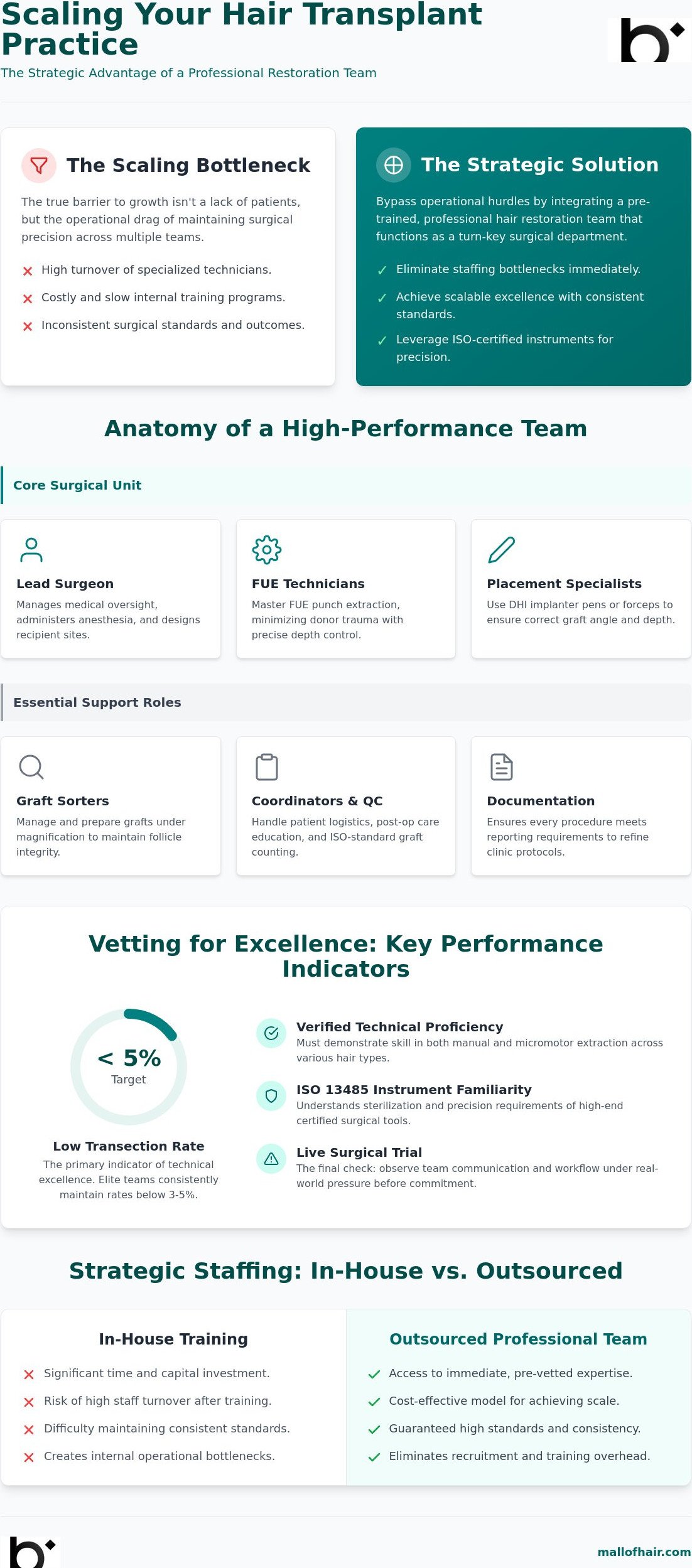
The lead surgeon provides the clinical foundation. They manage medical oversight, administer local anesthesia, and design the recipient sites. However, the heavy lifting of extraction is often handled by technicians who’ve mastered the FUE punch. These specialists must minimize donor trauma through tactile feedback and precise depth control. Once extracted, sorters manage the grafts under magnification, ensuring they’re ready for the placement specialists. These experts use DHI implanter pens or forceps with extreme care to ensure the correct angle and depth, which are critical for healthy growth.
Support Roles: Patient Coordinators and Post-Op Care
Success extends beyond the surgical suite. Patient coordinators manage the logistical flow and set realistic expectations, which reduces clinical stress. Technicians also play a vital role in educating patients on post transplant hair care to protect the clinic’s work during the vulnerable first few days. Every professional team needs a quality control lead for graft counting and documentation. This role ensures every procedure meets ISO-standard reporting requirements, providing the data necessary to refine clinic protocols and maintain high success rates.
How to Source and Evaluate a Professional Hair Transplant Team
Sourcing a hair restoration team for clinics requires a methodological approach to technical auditing. You shouldn’t rely solely on resumes or verbal claims of experience. Start by verifying technical proficiency in both manual and micromotor extraction. These methods demand distinct tactile skills and different levels of pressure. A technician who excels in manual extraction might struggle with the speed and heat management of a micromotor; vice versa is also true. It’s essential to verify their experience across various ethnic hair types. Afro-textured hair or fine Nordic hair present unique graft characteristics that require specific handling to avoid follicular damage.
Evaluating a professional team also involves assessing their alignment with modern clinical standards. While the U.S. Bureau of Labor Statistics defines general Surgical Technologist Roles, hair restoration is a hyper-specialized niche. You must evaluate the team’s familiarity with ISO 13485 certified instruments. This certification ensures they understand the sterilization and precision requirements of high-end equipment. Check references for specific metrics, such as graft-per-hour and clinical efficiency. Finally, always conduct a trial surgical day. This allows you to observe team communication and workflow under real-world pressure before making a long-term commitment. If you’re looking to bridge the gap between high-end tooling and expert staffing, you can consult with our specialists to explore tailored solutions.
Vetting for Technical Precision
A primary indicator of technical excellence is the documented transection rate. A professional hair restoration team for clinics should consistently maintain rates below 3-5%. Technicians must demonstrate proficiency in using various FUE punches, ranging from 0.7mm to 1.0mm, to adapt to different donor densities. Verification of training certifications from reputable institutions like the Aesthetic Academy provides an additional layer of security. These credentials ensure the staff has been trained on the latest protocols for graft hydration and temperature control during the sorting phase.
Cultural and Operational Fit
Technical skill is only half the equation. The unit must adapt to your clinic’s specific standard operating procedures without friction. For clinics serving international patients, multilingual teams are a significant asset for patient comfort. You should also evaluate the team’s capacity for high-density cases. Handling 4,000+ grafts in a single session requires a level of endurance and coordination that less experienced teams lack. Many clinics now source units from global hubs like Turkey to gain access to this high-volume expertise and operational discipline.
Integrating Specialized Instruments with Team Performance
Surgical excellence is achieved at the intersection of human dexterity and industrial precision. While some clinics market robotic systems as a way to eliminate human error, the reality is that a skilled hair restoration team for clinics often achieves more natural results when equipped with high-performance manual tools. The quality of these instruments directly dictates the ceiling of your team’s performance. Dull tools kill efficiency. When instruments are poorly balanced, technicians experience accelerated fatigue, which leads to slower extraction times and higher transection rates in the later stages of a procedure.
Integrating sapphire blade hair transplant techniques into your team’s workflow requires both specialized training and premium-grade equipment. Standardizing your clinic’s inventory with ISO-certified hair transplant instruments ensures that whether you’re using a new unit or your core staff, the results remain consistent. It’s about providing a professional environment where the staff doesn’t have to compensate for equipment failure.
The Impact of Ergonomics on Surgical Outcomes
Technician ‘hand-shake’ is a silent killer of graft quality during long sessions. Lightweight micromotors and ergonomic DHI pens aren’t luxuries; they’re essential for maintaining stability during 8-hour procedures. Sharpness is equally critical. A high-quality blade reduces the pressure needed for incision, thereby minimizing perifollicular trauma and improving patient recovery times. The Essential Duties of a Surgical Tech include the meticulous preparation of these instruments to ensure the surgical field remains efficient and sterile. Without ergonomic support, even the most talented staff will see a decline in precision as the day progresses.
Tool Maintenance and Team Responsibility
A professional team must take ownership of their toolkit. This includes strict adherence to sterilization protocols for sapphire blades, forceps, and implanters. Establishing a clear protocol for punch replacement is non-negotiable; even a slight loss in sharpness can compromise extraction precision. Technicians should be actively involved in selecting the hair transplant instrument set that best suits their specific technique. This involvement fosters a culture of responsibility and ensures that the hair restoration team for clinics has the tools necessary to maintain your clinic’s surgical standards across every case.
Training vs. Outsourcing: Strategic Staffing for Clinic Growth
The decision to cultivate an internal hair restoration team for clinics versus partnering with an external staffing provider is a critical pivot point for clinic growth. While some practitioners believe that in-house training is the only way to ensure quality, the operational reality often tells a different story. Building a unit from the ground up requires a massive investment in both time and capital, often leading to months of reduced surgical throughput. For clinics aiming to scale quickly, the strategic use of external expertise provides a path to immediate surgical excellence without the traditional overhead of recruitment.
A major concern for clinic owners is whether an outsourced team will care about their brand. In a professional partnership, the external unit operates as a strategic extension of your clinic. Their reputation is tied to your clinical outcomes. By integrating a high-performance unit that follows your specific protocols, you maintain brand integrity while benefiting from their specialized experience. If you’re ready to scale your operations with a turn-key surgical unit, contact our team to discuss staffing solutions tailored to your clinic’s needs.
The In-House Training Challenge
Internal training programs carry high hidden costs. Beyond salaries, you must account for the value of wasted grafts and equipment wear during the learning phase. It typically takes a technician several months to reach a master level where they can maintain low transection rates at high speeds. During this period, your clinic’s ROI is significantly suppressed. There’s also the persistent risk of poaching; once a technician is fully trained at your expense, they become a prime target for competitors, potentially leaving you with a staffing gap at a moment’s notice.
The Outsourced Team Advantage
Partnering with a specialized staffing provider offers immediate scalability. You can launch a new hair restoration department or expand your current capacity in weeks. This model provides predictable costs, as surgical units often operate on fixed per-case or per-day rates. This eliminates the unpredictability of full-time salaries and benefits during slow periods. Furthermore, hair transplant staff outsourcing grants your clinic access to “Turkey-Standard” expertise. This level of technical proficiency is difficult to find through local recruitment alone and ensures your patients receive world-class care from day one.
A hybrid model is often the most effective long-term strategy. By bringing in a professional hair restoration team for clinics to handle your core volume, you can use their expertise to mentor and train your local staff. This transition ensures your internal team learns global standards in a live surgical environment. Utilizing external training through an aesthetic academy hair transplant curriculum further reinforces these standards, providing your staff with certifications that validate their technical skills and commitment to excellence.
Partnering with Bind Pharma for Comprehensive Staffing and Tooling
Bind Pharma serves as the industrial bridge between high-end manufacturing and professional surgical staffing. When you source a hair restoration team for clinics from the same partner that manufactures your instruments, you eliminate the technical friction that often occurs with disparate suppliers. Our ISO 13485 certification ensures that every aspect of the unit, from the staff’s methodology to the precision of the tools, meets global medical standards. This synergy is the foundation of clinical success and operational reliability. It’s about creating a standardized environment where technical failure is not an option.
The integration of human expertise with industrial precision allows for a turn-key surgical solution. Through our Aesthetic Academy, we ensure that every technician is trained on the latest FUE and DHI tools before they arrive at your facility. This eliminates the learning curve and ensures immediate productivity from the first graft. We provide custom staffing and equipment packages designed to scale your clinic’s capacity without compromising on surgical excellence. By aligning your staffing needs with our manufacturing expertise, you secure a predictable path to growth.
The Bind Pharma Ecosystem
- Manufacturing: We produce premium FUE punches and ergonomic DHI pens designed to reduce technician fatigue and improve graft survival rates.
- Staffing: We provide professional hair transplant team staffing for global clinics seeking access to Turkey’s high-volume surgical expertise.
- Training: The Aesthetic Academy offers specialized upskilling for your existing staff, ensuring they stay current with evolving surgical protocols and instrument maintenance.
Global Reach and Reliable Logistics
Bind Pharma supports clinics across a vast geographical footprint, from the industrial hubs of Istanbul to established markets in the US and Europe. We don’t just provide personnel; we ensure a steady supply of surgical consumables to keep your operating rooms functional at all times. This comprehensive logistical support allows clinic owners to focus on patient acquisition while we handle the operational complexities of the surgical suite. Our commitment to quality ensures that your clinic maintains its reputation for excellence in a competitive market. Ready to scale your clinic? Contact our team today to secure a high-performance hair restoration team for clinics.
Securing Scalable Growth through Surgical Precision
Operational success in the hair transplant industry requires a shift from individual efforts to systematic excellence. You’ve seen how a multi-disciplinary unit reduces transection rates and how precision-engineered tools minimize technician fatigue. By prioritizing technical synergy, you protect your clinic’s reputation and ensure consistent patient outcomes. Securing a high-performance hair restoration team for clinics is the final step in establishing a sustainable growth model that avoids the bottlenecks of local recruitment and internal training delays.
Bind Pharma stands as your strategic partner in this evolution. As an ISO 13485 Certified Manufacturer and Global Wholesale Supplier, we provide the industrial reliability your practice demands. Our Aesthetic Academy training integration ensures that every unit we provide is proficient in the latest FUE and DHI protocols. It’s time to eliminate staffing instability and focus on clinical results. Scale Your Clinic with Bind Pharma’s Professional Teams and Instruments today. Your path to global standards starts with a single consultation.
Frequently Asked Questions
What is included in a professional hair restoration team for clinics?
A standard unit comprises a lead surgeon for medical oversight and site creation, extraction technicians for follicle harvesting, and placement specialists for graft insertion. This configuration ensures that each phase of the procedure is managed by a specialist, which significantly reduces the risk of graft damage during long sessions.
How many technicians are needed for a 3,000 graft FUE procedure?
A 3,000 graft FUE procedure generally requires a hair restoration team for clinics consisting of one lead surgeon and three to four technicians. This specific ratio is necessary to maintain a graft-per-hour rate that ensures follicles remain outside the body for the shortest time possible, protecting graft viability.
Can an outsourced hair transplant team use my clinic’s existing equipment?
External teams can utilize your existing equipment provided it meets professional standards for precision and sterilization. Many units prefer using standardized, ISO-certified instruments such as sapphire blades and high-precision punches to ensure their technical performance remains consistent with their specialized training and previous clinical results.
How do I ensure the quality of an external hair restoration team?
You should verify the team’s documented transection rates and request specific references for high-density cases. A professional hair restoration team for clinics will provide data showing transection rates below 5% and will often hold certifications from recognized training bodies, such as the Aesthetic Academy, to prove their technical proficiency.
What is the difference between an FUE technician and a DHI specialist?
FUE technicians specialize in the extraction phase, using punches to harvest follicles from the donor area with minimal trauma. DHI specialists focus on the placement phase; they utilize implanter pens to control the depth, angle, and direction of each graft without the need for pre-made incisions in the recipient site.
Is it better to hire a team from Turkey for my international clinic?
Hiring a team from Turkey is often advantageous due to their extensive exposure to high-volume surgical environments. These teams bring a level of technical proficiency and operational discipline that is difficult to replicate through local recruitment, making them a strategic asset for clinics aiming for world-class results.
How long does it take to integrate a new surgical unit into my clinic?
Integration typically requires one to two weeks of operational alignment to ensure the team understands your local protocols. This period usually includes a trial surgical day to observe how the team adapts to your clinic’s specific SOPs and interacts with your local administrative and post-op care staff.
What training certifications should I look for in hair restoration staff?
Priority should be given to staff with certifications from reputable institutions such as the aesthetic academy hair transplant programs. You should also verify that their training history includes ISO 13485 standards for instrument handling and sterilization; this ensures total compliance with international medical regulations and maintains your clinic’s safety standards.