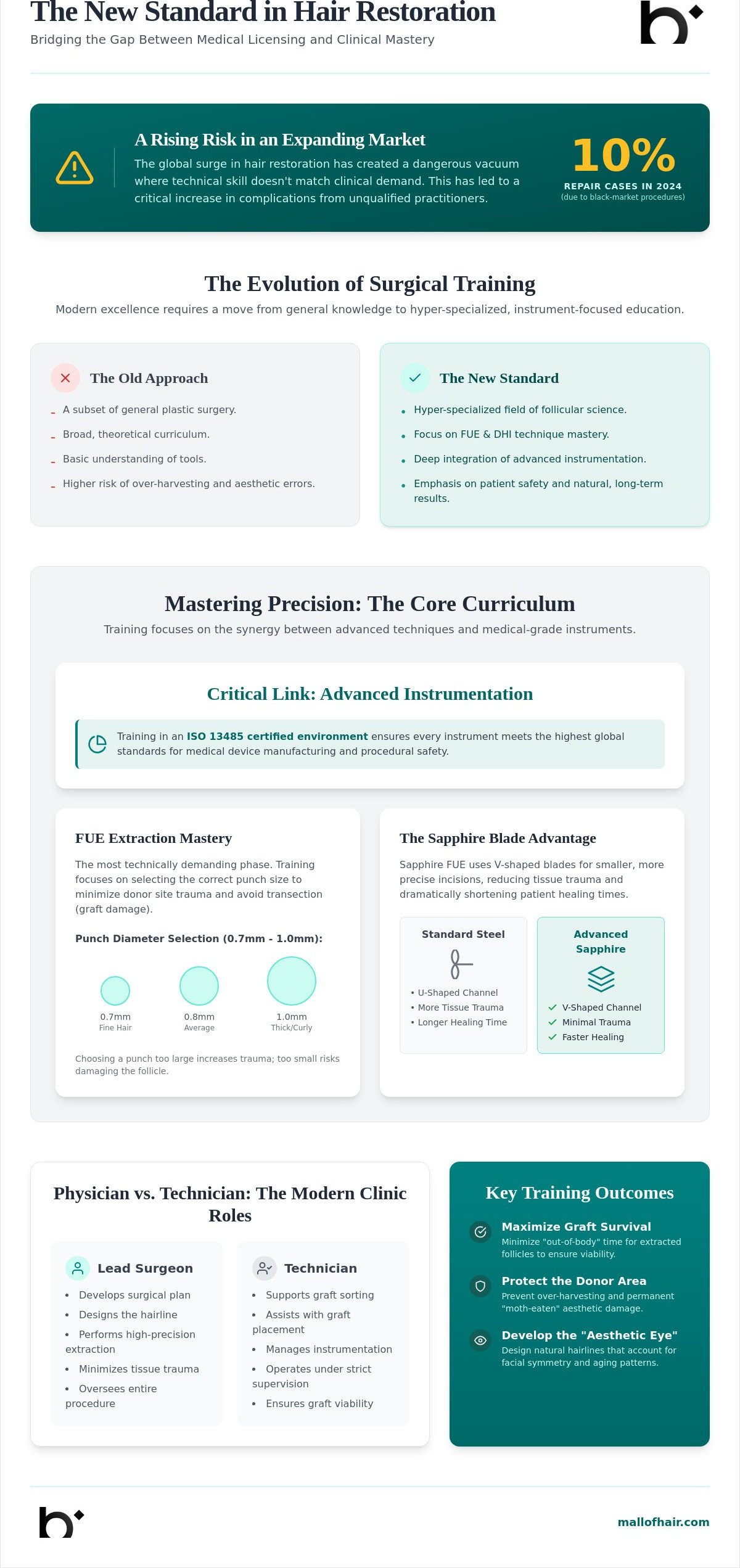
Statistics from the International Society of Hair Restoration Surgery reveal that repair cases due to black-market procedures rose to 10% in 2024. You’re likely aware that the global surge in hair restoration has created a dangerous vacuum where technical skill doesn’t always match clinical demand. Finding an aesthetic academy hair transplant curriculum that offers genuine hands-on experience with premium instruments like Sapphire blades and DHI implanters is the only way to ensure patient safety and surgical excellence in a competitive market.
It’s clear that your clinic’s reputation depends on the precision of your team and the quality of your tools. This guide shows you how to master the intersection of surgical precision and advanced instrumentation through the industry’s leading restoration training framework. We’ll examine the technical mastery of FUE and DHI tools, the requirements for global certification, and how to build a professional network that eliminates your staffing hurdles. You’ll gain the insights needed to bridge the gap between basic medical licensing and true clinical mastery.
Key Takeaways
- Understand the transition from general aesthetic medicine to hyper-specialized restoration through a structured aesthetic academy hair transplant framework.
- Master advanced FUE and DHI techniques through comprehensive modules focusing on technical precision and varied surgical punch diameters.
- Learn why utilizing ISO-certified, medical-grade instruments such as Sapphire blades and Titanium forceps is essential for optimizing patient healing times.
- Discover operational strategies for integrating professional, pre-trained surgical teams to ensure immediate clinical excellence in new facilities.
- Identify the technical advantages of choosing a training program backed by medical device manufacturing expertise for superior instrumentation grounding.
What is an Aesthetic Academy Hair Transplant Program?
An aesthetic academy hair transplant program is a specialized educational framework. It moves beyond general cosmetic surgery into the art and science of follicular unit restoration. In the past, hair restoration was often a subset of general plastic surgery. Today, it’s a hyper-specialized field requiring dedicated training. This transition ensures that practitioners don’t just perform a procedure but master the biological and technical nuances of scalp anatomy. The curriculum focuses on the synergy between surgical skill and the high-performance instruments required for modern results.
For an Overview of Hair Transplantation, one must look at how methods have evolved from basic strip surgery to precision extraction. By 2026, industry standards demand proficiency in both Follicular Unit Extraction (FUE) and Direct Hair Implantation (DHI). These methods require different instrumentation and manual dexterity. Professional surgical education now takes place in ISO 13485 certified environments. This certification isn’t just a label; it’s a rigorous commitment to the highest quality standards in medical device manufacturing and procedural safety. Training in such an environment ensures that every instrument meets global safety benchmarks.
The Core Objectives of Professional Restoration Training
The primary goal is maximizing graft survival rates. This is achieved by minimizing the time grafts spend outside the body. Students learn to manage the “out-of-body” window with precision. Another critical objective is respecting the biological limits of the donor area. Over-harvesting is a common error in under-trained clinics, leading to permanent aesthetic damage and “moth-eaten” donor zones. Finally, a professional program develops the “aesthetic eye.” This involves designing hairlines that account for facial symmetry, bone structure, and future aging patterns to ensure natural results.
Technician vs. Physician Roles in the Modern Clinic
Clear boundaries are essential for clinical safety. The lead surgeon holds the responsibility for the surgical plan and high-precision extraction phases. They oversee the use of specialized FUE punchs to ensure minimal tissue trauma. Technicians play a vital role in graft sorting and placement support, but they operate under strict medical supervision. Specialized training significantly reduces the risk of transection during FUE. This technical proficiency ensures that every follicle remains viable for successful transplantation and long-term density.
Core Curriculum: Mastering FUE and DHI Techniques
A high-performance aesthetic academy hair transplant curriculum prioritizes technical depth over theoretical broadness. The training begins with a comprehensive analysis of the patient journey. This starts at the initial consultation, moves through preoperative planning, and extends to long-term aftercare protocols. Adhering to established Hair Transplant Practice Guidelines ensures that every step meets international safety standards. Mastery in 2026 requires more than just basic knowledge; it demands an expert understanding of how specific blade geometries and instrument materials influence tissue regeneration and graft survival.
The science of Sapphire FUE is a primary focus in modern training. Unlike standard steel blades, Sapphire blades feature a V-shaped geometry that allows for smaller, more precise incisions. This specific geometry reduces the amount of force required to open a channel. Lower force results in less tissue trauma and significantly shorter healing times for the patient. Trainees learn to calculate the exact angle and depth for channel opening, ensuring the recipient site is perfectly prepared to receive the extracted follicles without causing unnecessary scaring.
FUE Extraction Mastery and Punch Selection
Extraction is the most technically demanding phase of the procedure. Students receive intensive instruction on both manual and micromotor extraction techniques. A critical skill developed here is the ability to select the correct FUE punch size based on the patient’s hair follicle characteristics. Punch diameters typically range from 0.7mm to 1.0mm. Choosing a punch that’s too large increases donor site trauma, while one that’s too small risks transecting the graft. Precision tool handling is taught to minimize these risks, ensuring the donor area remains healthy for future needs.
The DHI Method: Precision with Implanter Pens
The Direct Hair Implantation (DHI) method represents the pinnacle of placement precision. Training focuses on the high-dexterity task of loading and deploying DHI implanter pens effectively. Trainees must master the rhythm of the procedure to keep graft out-of-body time to a minimum. Maintaining graft hydration and temperature during this phase is vital. By utilizing specialized implanter pens, clinicians can achieve high-density results without damaging existing native hair. This “no-shave” approach is increasingly popular, but it requires a level of skill that only rigorous academy training can provide. If you’re looking to elevate your clinic’s technical capabilities, you can consult with our experts regarding professional training modules.
The Critical Link Between Surgical Instruments and Technician Proficiency
Clinical excellence is never an isolated result of manual dexterity. It’s the direct consequence of the synergy between a trained hand and high-performance equipment. A professional aesthetic academy hair transplant program recognizes that technician proficiency is capped by the quality of the instruments provided. Training on ISO-certified, medical-grade instruments is a non-negotiable safety requirement. Utilizing substandard tools introduces variables that even the most skilled surgeon cannot fully control. This leads to inconsistent results and increased patient risk. Mastery requires a deep understanding of why certain tools are used for specific tissue types.
Understanding the engineering behind hair transplant instruments is vital for maintaining a productive surgical flow. The material choice, such as Titanium versus Stainless Steel, directly impacts healing times and operator fatigue. Titanium instruments provide a lightweight yet durable alternative that enhances tactile feedback during graft handling. High-quality forceps and sapphire blades are specifically engineered to prevent graft ‘crush’ injuries. These injuries occur when follicles are subjected to mechanical stress during the implantation phase. A precise, sharp blade ensures the recipient channel is perfectly sized. This allows the graft to slide into place without trauma. Programs like the ISHRS Fellowship Training Program consistently highlight the necessity of professional-grade instrumentation for achieving the highest standards of clinical success.
Sourcing Professional Grade Equipment
Wholesale surgical tools often lack the microscopic consistency required for follicular unit restoration. Premium manufactured instruments undergo rigorous quality control to ensure every FUE punch and DHI pen operates within micron-level tolerances. Clinics must verify the manufacturing origin of their surgical kits. This avoids the technical failures associated with mass-produced, uncertified alternatives. High-precision FUE punches must maintain a perfect concentricity to ensure the extraction is clean and the graft remains intact.
Instrument Maintenance and Sterilization Protocols
Longevity in high-frequency clinical environments depends on strict sterilization protocols. Sapphire blades and micromotor tips require standardized cleaning to prevent residue buildup that can dull the edges. You must replace FUE punches at regular intervals. Using a dull punch leads to tissue tearing and increased transection rates. This undermines the entire surgical outcome and donor area health. Maintaining a strict replacement schedule ensures that every incision is as sharp as the first, preserving the integrity of the patient’s scalp tissue.
Operational Excellence: Staffing Solutions and Team Integration
Operational success in hair restoration depends on more than just the surgical lead. It requires a cohesive unit where every member understands the precision required for graft survival. While individual training at an aesthetic academy hair transplant center provides the technical foundation, the challenge lies in bridging the gap between classroom skill and full-scale clinic operations. For new facilities, the integration of pre-trained, professional teams is often the most efficient path to profitability. This approach ensures that ISO standards and clinical protocols are maintained without the downtime associated with training entry-level staff.
Evaluating the return on investment (ROI) between in-house technician training and professional outsourcing is a strategic necessity. In-house training involves significant time and resource allocation, often taking six to twelve months for a technician to reach peak efficiency. Conversely, utilizing a pre-trained Hair Restoration Team for Clinics allows for immediate surgical throughput. This strategic guide to staffing highlights how clinics can bypass the technical gap and focus on patient acquisition from day one. By 2026, the ability to deploy expert staff rapidly is a key differentiator in the global market.
Staffing Models for Global Clinics
Clinic owners must choose between several operational structures based on their patient volume and growth targets. The Hair Transplant Staff Outsourcing vs. In-House Teams debate centers on flexibility and cost control. Outsourced teams allow clinics to scale capacity during peak demand periods without the burden of permanent overhead. However, maintaining quality control is paramount. You must ensure that any integrated external team uses the same high-precision instruments and standardized protocols as your primary staff to prevent inconsistencies in patient results.
Continuous Education and Skill Retention
Technological shifts in 2026, including robotic assistance and advanced graft preservation methods, require constant updates. An aesthetic academy hair transplant framework shouldn’t end at initial certification. Implementing regular skill assessments for senior technicians ensures that the precision of extraction and implantation remains at elite levels. Ongoing professional development prevents technical stagnation and keeps your facility at the forefront of the industry’s projected growth. To secure a high-performance workforce for your facility, you can request a professional hair transplant team consultation.
Choosing the Right Aesthetic Academy for Your Clinical Goals
Selecting an institution for your aesthetic academy hair transplant training requires a meticulous evaluation of three specific pillars: accreditation, faculty expertise, and instrument quality. While many programs offer theoretical knowledge, few provide the technical grounding necessary to operate at a global standard. A professional clinician must look beyond the curriculum to see if the academy utilizes the same high-performance tools they will use in their daily practice. Clinical success is an outcome of rigorous standards. If an academy can’t verify the manufacturing origin of its surgical kits, it can’t guarantee the precision of the training. Training on substandard equipment creates bad habits that are difficult to correct in a live clinical environment.
The integration of post-transplant hair care education is a critical component of a comprehensive curriculum. A successful procedure is only the beginning of the patient’s journey. Clinicians must understand how to manage the scalp’s recovery phase using post transplant hair care products to optimize graft survival and minimize inflammation. Training that omits this phase leaves a significant gap in the clinic’s service offering. By 2026, patients expect a full-cycle restoration experience that includes detailed aftercare protocols and professional guidance. Ensuring your team is proficient in post-operative management is as vital as the surgery itself.
Before enrolling in a hair restoration course, use this final checklist to evaluate the program’s value:
- Does the faculty have documented, hands-on experience with both Sapphire FUE and DHI methods?
- Are the training instruments, including FUE punches and DHI pens, ISO 13485 certified?
- Does the program provide access to a professional network for staffing and equipment supply?
- Is there a clear focus on reducing graft transection through technical mastery of the micromotor?
The Bind Pharma / Aesthetic Academy Advantage
Training at an academy backed by a manufacturer like Bind Pharma provides a superior technical foundation. Every module integrates ISO 13485 manufacturing standards. This ensures you understand the engineering of your hair transplant instruments from the ground up. Participants gain direct access to a global wholesale network for premium surgical tools, including Sapphire blades and Titanium forceps. This ecosystem provides comprehensive support, moving from initial training to staffing and reliable instrument supply. It’s a strategic partnership designed for long-term clinical excellence.
Next Steps for Aspiring Professionals
Aspiring professionals should prepare for upcoming 2026 certification programs by auditing their current clinical infrastructure. Integrating new techniques like DHI requires specific tools and a staff trained in high-dexterity loading. Preparing your clinic for these advancements involves more than just buying equipment; it requires a culture of precision. Building a long-term partnership with a professional academy ensures your clinic remains at the forefront of technical innovation. To begin your transition toward surgical mastery, you can submit your application for professional training today.
Advancing Surgical Standards in Hair Restoration
Clinical excellence in hair restoration isn’t achieved through technical skill alone. It requires the seamless integration of expert training and high-performance surgical tools. Throughout this guide, we’ve explored how a professional aesthetic academy hair transplant program bridges the gap between basic medical licensing and true mastery of FUE and DHI techniques. By focusing on the engineering of precision instruments and the efficiency of pre-trained teams, clinics can significantly improve patient outcomes and operational throughput.
As an ISO 13485 certified manufacturer and a global supplier of FUE and DHI instruments, Bind Pharma remains committed to elevating industry standards. Whether you’re seeking advanced training, professional staffing solutions for your facility, or premium surgical kits, we provide the technical grounding required for long-term success. It’s time to align your clinical practice with the highest global benchmarks for safety and precision. We look forward to supporting your journey toward surgical excellence.
Explore Professional Training and Premium Instruments at Bind Pharma
Frequently Asked Questions
What is the primary focus of an aesthetic academy hair transplant course?
The primary focus is the technical mastery of follicular unit restoration. This involves a specialized educational framework that covers the entire patient journey from initial consultation to advanced surgical execution. An aesthetic academy hair transplant program ensures that practitioners understand the biological nuances of the scalp while mastering high-precision instruments to maximize graft survival rates.
Do I need a medical degree to attend hair transplant training?
Requirements depend on the specific clinical role you intend to fill. Lead surgeons must hold a valid medical degree to perform extractions and oversee the surgical plan. However, technicians and assistants who focus on graft sorting and implantation support typically require a background in nursing or healthcare. All professional programs adhere to international standards to ensure participants operate within their legal boundaries.
How long does a professional hair transplant certification take?
Certification timelines vary based on the depth and intensity of the curriculum. Intensive hands-on courses often span several days of direct surgical practice under expert supervision. More comprehensive fellowship programs can extend over several months to ensure total mastery of the aesthetic academy hair transplant framework. Each path focuses on moving the participant from foundational theory to technical proficiency through repeated practice.
Is the training valid for both FUE and DHI techniques?
Yes, the training covers both Follicular Unit Extraction (FUE) and Direct Hair Implantation (DHI) methodologies. Mastery of these distinct techniques is essential for any modern clinic aiming for clinical excellence. Participants learn the specific manual dexterity required for DHI implanter pens and the precision needed for Sapphire FUE channel opening to ensure they can meet diverse patient needs.
Are the instruments used in training available for wholesale purchase?
All ISO-certified instruments used during the training modules are available for wholesale acquisition. This includes FUE punches, Sapphire blades, and DHI implanter pens. Providing access to a global wholesale network ensures that clinics can maintain the same high standards in their daily operations that were established during their training phase.
What are the benefits of training at an academy that manufactures its own tools?
Training at a manufacturer-backed academy offers superior technical grounding and deeper insight into instrument engineering. Participants learn how blade geometry and material choices, like Titanium or Stainless Steel, directly impact patient healing times. This integration of ISO 13485 manufacturing standards into the curriculum ensures that clinicians understand exactly how their instruments interact with scalp tissue for optimal results.
Does the academy provide assistance with clinic staffing after graduation?
Professional staffing solutions are a core component of the operational support provided. The academy helps clinics bridge the technical gap by providing access to pre-trained, professional hair transplant teams. This service allows new facilities to scale their surgical capacity rapidly without the downtime associated with training entry-level staff from scratch.
How does the curriculum address post-transplant patient care?
The curriculum includes dedicated modules on post-transplant hair care to ensure a full-cycle restoration experience. Clinicians learn to manage the recovery phase using specialized post transplant hair care products that optimize graft survival and minimize inflammation. This comprehensive approach ensures that the patient’s journey is managed effectively from the final incision through the full growth cycle of the transplanted follicles.