Is your clinic’s expansion being throttled by the twelve month lead time required to train a single reliable technician? Most clinic owners understand that high staff turnover and the staggering costs of technical training are the primary obstacles to scaling a hair restoration practice. Finding and retaining a team that can deliver consistent, high level FUE and DHI results is an ongoing operational struggle that drains both time and capital. It’s a bottleneck that prevents even the most successful surgeons from reaching their full potential.
By evaluating the strategic impact of hair transplant staff outsourcing against traditional in-house models, you’ll discover how to secure immediate expertise while significantly reducing your overhead. This comparison breaks down the financial implications of both staffing strategies, the reality of surgical outcome predictability, and how to choose the model that aligns with your long-term growth objectives. Whether you’re managing a boutique practice or a high volume center, the choice between internal development and external partnership determines your clinical efficiency.
Key Takeaways
- Understand the financial shift from fixed in-house salaries to a variable cost model through hair transplant staff outsourcing to protect clinic margins.
- Eliminate the intensive 6-12 month training period by gaining immediate access to technicians already proficient in advanced FUE and DHI procedures.
- Identify critical evaluation metrics for staffing partners, including graft survival data and standardized technical certifications from recognized institutions like the Aesthetic Academy.
- Mitigate operational risks by utilizing teams trained on high-precision surgical instruments, ensuring surgical consistency across all patient cases.
Strategic Staffing in Hair Restoration: The Rise of Outsourcing
Hair transplant staff outsourcing is no longer just a temporary fix for labor gaps. It’s a calculated strategic partnership. In a sector where global demand reached over 700,000 procedures in 2024, the pressure on human capital is immense. The hair restoration industry faces a critical shortage of skilled technicians capable of performing high-volume extractions. This scarcity has transformed Medical outsourcing from a peripheral business practice into a core growth strategy for modern clinics. By 2026, the ability to scale operations quickly through external professional teams has become a prerequisite for maintaining market share and clinical reputation.
A complete outsourced team typically includes lead surgeons, specialized technicians, and surgical assistants. These professionals don’t just fill seats; they bring standardized protocols that ensure surgical outcomes remain predictable regardless of internal staffing fluctuations. For the clinic owner, this model shifts the focus from managing HR crises to optimizing patient throughput and aesthetic excellence, reflecting the same attention to detail that clients expect from luxury brands like Millo Beauty.
The Evolving Landscape of Hair Restoration Labor
The industry’s transition from Follicular Unit Transplantation (FUT) to advanced methods like Follicular Unit Extraction (FUE) and Direct Hair Implantation (DHI) fundamentally changed labor requirements. These newer techniques are labor-intensive. They require multiple technicians to handle graft extraction and placement simultaneously. High turnover rates among permanent staff often disrupt this delicate balance, leading to operational instability. Outsourced teams provide the flexibility needed to manage seasonal spikes or the influx of patients common in medical tourism hubs. It’s about maintaining operational capacity without the burden of permanent fixed costs or the risk of sudden staff departures.
Why Clinical Precision Starts with the Right Team
Technical expertise directly correlates with graft survival rates. A technician’s speed and precision during the extraction phase determine the viability of the follicles. Professional teams integrate into existing clinic workflows because they’re accustomed to high-pressure environments and diverse surgical styles. Success in these procedures relies on the synergy between human skill and technical equipment. For instance, utilizing a medical grade FUE punch is essential for minimizing donor site trauma and ensuring graft integrity. When an expert team uses precision-engineered instruments, the clinic achieves a level of consistency that’s difficult to replicate with an in-house team undergoing constant training. This partnership allows surgeons to focus on aesthetic design while the technical team executes the repetitive, high-precision tasks with industrial discipline.
Hair Transplant Staff Outsourcing vs. In-House Teams: A Comprehensive Comparison
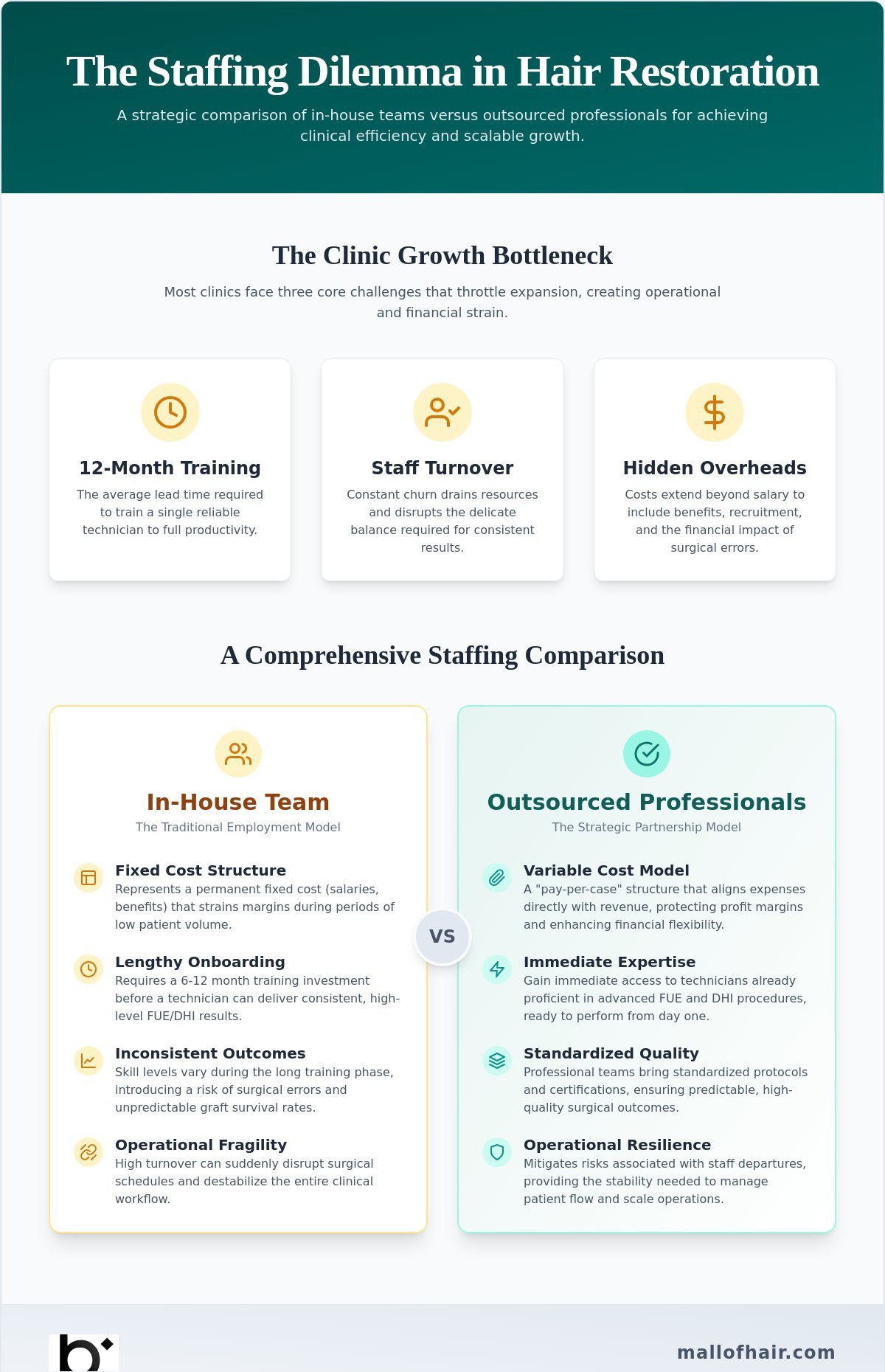
Choosing between an internal department and hair transplant staff outsourcing is a decision that defines a clinic’s financial architecture. An in-house team represents a permanent fixed cost. Regardless of whether you perform ten or fifty procedures a month, your overhead remains static. In contrast, outsourcing utilizes a variable cost model. This approach allows clinic owners to align their expenses directly with their revenue, creating a “pay-per-case” structure that protects profit margins during low-demand periods. Decision-makers must carefully weigh the opportunities and challenges of outsourcing to determine which path supports their specific scaling objectives.
The burden of education and skill maintenance is another critical differentiator. Building an in-house team requires a 6-12 month investment in training before a technician reaches full productivity. During this time, the clinic bears the cost of salary, benefits, and potential surgical errors. Professional outsourced units arrive fully certified and ready to perform. Outsourcing often eliminates the need for the clinic to procure specialized surgical tools for every case, as professional teams frequently arrive with their own precision equipment.
Financial Analysis: ROI of Outsourced Units
Hidden costs often undermine the perceived value of in-house hiring. Beyond base salaries, clinics must account for health insurance, paid leave, and the significant expense of downtime. When a surgery is canceled, an in-house team still costs money. An outsourced partner only bills for completed procedures. This shift from a capital-heavy model to an operational-expense model improves cash flow. It allows for rapid expansion into new markets without the massive upfront investment typically required for recruitment and local training. For a detailed look at how these teams integrate into your current facility, consult this Hair Restoration Team for Clinics: A Strategic Guide to Staffing and Integration.
Operational Flexibility and Risk Management
Small to mid-sized clinics often face “key person” dependency. If a lead technician resigns, the entire surgical schedule collapses. Outsourcing provides a deep bench of talent, ensuring that procedures continue without interruption. These teams bring diverse experience gathered from multiple global facilities, often introducing more efficient protocols to your practice. Result consistency is also tied to equipment quality. A team that uses high-performance hair transplant instruments delivers superior graft survival rates compared to a revolving door of trainees using basic tools. You can discuss your clinic’s specific staffing requirements with our specialists to find a balanced solution.
Critical Evaluation Criteria for Outsourced Staffing Partners
Vetting a partner for hair transplant staff outsourcing requires more than a cursory review of technical resumes. It demands a rigorous analysis of clinical data, including historical graft survival rates and verified case studies. A high-performing team must demonstrate a mastery of both Follicular Unit Extraction (FUE) and Direct Hair Implantation (DHI) across diverse patient demographics. Technical versatility isn’t just a bonus; it’s a requirement for clinics that prioritize surgical excellence and patient safety. You shouldn’t settle for teams that can’t provide documented evidence of their surgical success.
Beyond individual talent, the most reliable partners operate under a framework of standardized training. This is where the influence of an institution like the Aesthetic Academy becomes a decisive factor. When technicians are trained within a structured aesthetic academy hair transplant curriculum, they adhere to uniform protocols that eliminate the variance often found in self-taught or informally trained staff. This predictability is the foundation of a successful clinical partnership. It ensures that every procedure follows the same high standard, regardless of which specific team members are on-site.
Certification and Quality Standards
Quality assurance in staffing is often a reflection of the partner’s broader industrial standards. A provider whose manufacturing arm maintains ISO 13485 certification demonstrates a deep commitment to medical-grade precision that naturally extends to their clinical teams. This certification ensures that the environment where tools are developed and technicians are trained meets international regulatory requirements. You should evaluate the provider’s training curriculum to ensure it covers the latest advancements in graft handling and site creation. Proficiency in both FUE and DHI allows your clinic to offer a full spectrum of services without the need for multiple specialized vendors.
The Importance of Tool Proficiency
The synergy between a technician and their instruments determines the final aesthetic outcome. Expert staff must possess an instinctive understanding of how to handle high-precision FUE punches and sapphire blades. Inexperienced handling of these tools can lead to excessive donor trauma or poor graft placement, which directly damages your clinic’s reputation. A technician’s ability to select the correct punch diameter and manage the depth of extraction is a skill honed through thousands of procedures. For a deeper understanding of how equipment manufacturing influences surgical success, refer to this guide on FUE Punch Manufacturer: The Ultimate Guide to Sourcing Surgical Precision (2026). Ensuring your outsourced team is proficient with premium instruments is the final safeguard against inconsistent results.
Common Pitfalls in Staff Outsourcing and How to Avoid Them
While the financial benefits of hair transplant staff outsourcing have been established in previous sections, many clinic owners fear a decline in surgical consistency. This “Quality Gap” isn’t an inherent flaw of the outsourcing model; it’s usually a result of poor technical alignment. Inconsistent surgical results often occur when external teams use unfamiliar equipment or follow protocols that differ from the clinic’s established standards. To avoid this, you must treat the outsourced unit as a technical extension of your brand, not a separate entity. Consistency is a byproduct of rigorous protocol enforcement.
Legal and regulatory hurdles also present significant risks that clinic owners often overlook. Compliance isn’t universal. In the United States, state medical boards dictate the specific tasks a technician can legally perform. A clinic in California operates under different delegation rules than one in Florida or Texas. Failing to vet an outsourcing partner’s understanding of these local regulations can expose your practice to severe liability. It’s your responsibility to ensure that the external team’s clinical scope matches your local legal requirements to avoid costly litigation or board sanctions.
Bridging the Communication Gap
Communication breakdowns between clinic management and external teams often happen during the patient hand-off. To prevent this, you must set clear, data-driven KPIs for graft transection rates and donor site management. Every technician should be evaluated against these metrics in real-time. Establishing a standardized workflow ensures that the transition from the initial consultation to the extraction phase remains seamless. Using high-quality, standardized hair transplant instruments is the most effective way to guarantee uniform results. When every technician uses the same precision-engineered tools, the technical variance between different teams is virtually eliminated.
Maintaining Brand Standards with External Teams
A clinic’s reputation is built on its unique patient experience. Dependency on an external team shouldn’t mean losing your brand identity. You can successfully white-label an outsourced team by requiring them to follow your specific post-operative care protocols and patient communication styles. If your brand is synonymous with sapphire-tipped precision, the team must be proficient with your preferred sapphire blades. This continuity ensures that the patient perceives a single, unified medical team. Maintaining this level of control requires a partner who respects your clinical hierarchy and aesthetic philosophy. You can contact our clinical advisors to design a staffing integration plan that protects your brand’s integrity.
Optimizing Clinic Operations with Mall of Hair’s Professional Teams
Mall of Hair provides a sophisticated framework for hair transplant staff outsourcing by synthesizing Turkish surgical heritage with international quality standards. Turkey remains a global hub for hair restoration, performing over 500,000 procedures annually. We leverage this concentrated expertise to provide clinics with teams that aren’t just experienced, but are masters of high-volume, high-precision environments. Our staffing solutions allow your clinic to bypass the regional talent shortages that often stall growth, providing immediate access to a workforce that understands the nuances of graft survival and patient aesthetics.
The Mall of Hair model treats staffing as a component of a larger technical ecosystem. We don’t simply provide labor; we provide a calibrated surgical unit. This approach ensures that your clinic maintains operational continuity regardless of local market fluctuations or internal staff turnover. By integrating our professional teams, you gain a strategic partner dedicated to maintaining your clinical reputation through disciplined surgical execution and predictable patient outcomes.
The Aesthetic Academy: Setting the Standard for Technicians
The primary differentiator of our team is the Aesthetic Academy. Every technician we provide undergoes rigorous training within this institution, ensuring they’re experts in the latest FUE extraction and DHI implantation protocols. In 2026, surgical techniques have evolved to require even greater precision; our staff remains at the cutting edge of these developments. Hiring staff who are factory-trained on the very instruments they use eliminates the learning curve that typically hampers outsourced units. This “Technician-Tool Synergy” ensures that the transition into your clinic’s workflow is immediate and error-free. Our commitment to continuous education means your clinic always benefits from the most advanced graft-handling methodologies available in the industry. To understand the full scope of what this structured training framework delivers, explore our aesthetic academy hair transplant professional training and clinical excellence guide.
Seamless Integration of Staff and Instruments
Clinics choose Mall of Hair because we offer a total surgical solution. We understand that even the most skilled hands require premium instruments to achieve excellence. When you partner with us, your team arrives with a deep proficiency in using our medical-grade FUE punches and DHI pens. This integration minimizes the risk of graft transection and maximizes donor site preservation. You no longer need to manage separate vendors for staffing and surgical supplies. We provide the expertise and the tools in a single, streamlined package. To begin optimizing your clinical throughput and elevating your surgical standards, you can contact Mall of Hair to discuss your professional hair transplant team needs and schedule a strategic consultation.
Future-Proofing Clinical Growth through Strategic Staffing
Scaling a hair restoration practice requires a departure from traditional, capital-heavy labor models. You’ve seen how hair transplant staff outsourcing transforms fixed overhead into a flexible, performance-driven asset. By eliminating the 6-12 month training bottleneck and mitigating the risks of staff turnover, you can focus on surgical design and patient acquisition. The synergy between high-precision instruments and expertly trained hands is the only way to ensure graft survival rates remain consistent across every procedure. It’s a shift from managing human resource crises to overseeing clinical excellence.
As an ISO 13485 certified manufacturer and global wholesale supplier of premium FUE and DHI tools, Mall of Hair provides a complete operational solution. Our Aesthetic Academy trained technicians represent the pinnacle of technical discipline, arriving factory-trained on the very instruments they use. This integrated approach guarantees that your clinic operates at the highest international standards from day one. It’s time to optimize your surgical throughput and protect your clinical reputation with a partner that understands the industrial precision required for success.
Partner with Mall of Hair for Professional Hair Transplant Staffing and secure your clinic’s operational future today.
Frequently Asked Questions
What are the main benefits of hair transplant staff outsourcing?
The primary benefits include immediate access to high-level expertise and the conversion of fixed payroll into variable operational costs. hair transplant staff outsourcing allows clinics to scale up during peak medical tourism seasons without the long-term liability of permanent hires. This model eliminates the 6-12 month training period required for new in-house technicians, ensuring your clinic remains productive and profitable from the first day of partnership.
How do outsourced technicians affect the cost per hair transplant procedure?
Outsourcing transforms labor from a static fixed cost into a variable “pay-per-case” expense, which stabilizes the cost per procedure. By only paying for technicians when surgeries are scheduled, clinics protect their profit margins during low-demand periods. This financial structure removes the burden of paying salaries, benefits, and insurance during downtime, allowing clinic owners to allocate capital toward marketing or infrastructure rather than idle human resources.
Is the quality of outsourced hair transplant teams as high as in-house staff?
Quality is maintained through standardized protocols and the extensive procedural volume that outsourced technicians handle across multiple global facilities. While in-house staff offer local familiarity, professional outsourced units bring a level of specialized expertise that’s difficult to replicate internally. These teams are often trained in high-volume hubs like Turkey, performing thousands of extractions annually, which results in superior graft survival rates and surgical consistency.
What certifications should I look for in a hair transplant staffing provider?
You should prioritize providers who demonstrate ISO 13485 certification in their manufacturing arms and formal technical certifications from institutions like the Aesthetic Academy. These credentials ensure the team adheres to international medical standards and understands the technical mechanics of the instruments they use. Verifying a provider’s historical graft survival data and documented case studies is also essential for confirming their clinical reliability and technical proficiency.
Can outsourced teams work with both FUE and DHI techniques?
Yes, professional outsourced teams are specifically trained to be proficient in both Follicular Unit Extraction (FUE) and Direct Hair Implantation (DHI) techniques. This versatility allows your clinic to offer a broader range of hair restoration services without hiring separate specialists. Technicians maintain high precision in graft handling and implantation regardless of the method, ensuring that your aesthetic results meet the specific requirements of each patient case.
How does Mall of Hair’s Aesthetic Academy train its technicians?
Mall of Hair’s Aesthetic Academy utilizes a standardized curriculum that focuses on technical mastery and factory-level knowledge of surgical instruments. Technicians are trained in a simulated clinical environment to ensure they follow uniform protocols for every procedure. This training includes deep proficiency in using FUE punches and DHI pens, ensuring that every team member operates with the same industrial discipline and technical precision required for high-volume success.
What happens if an outsourced team member is not a good fit for my clinic?
Contractual flexibility allows you to request team adjustments or replacements if a specific technician doesn’t align with your clinic’s workflow or brand culture. Unlike in-house employees, who require complex termination and recruitment processes, outsourced partners provide a deep bench of talent to ensure continuity. This model removes the HR burden from the clinic owner, allowing for a seamless transition to a team member who better fits your facility’s requirements.
Do outsourced teams bring their own surgical instruments like FUE punches?
Many professional teams arrive equipped with their own precision-engineered instruments, including factory-calibrated FUE punches and DHI implanter pens. This ensures that the technicians are working with tools they’ve mastered through thousands of procedures. By utilizing hair transplant staff outsourcing that includes instrument provision, clinics can reduce their own equipment procurement costs while ensuring that every surgery is performed with medical-grade, high-performance hardware.