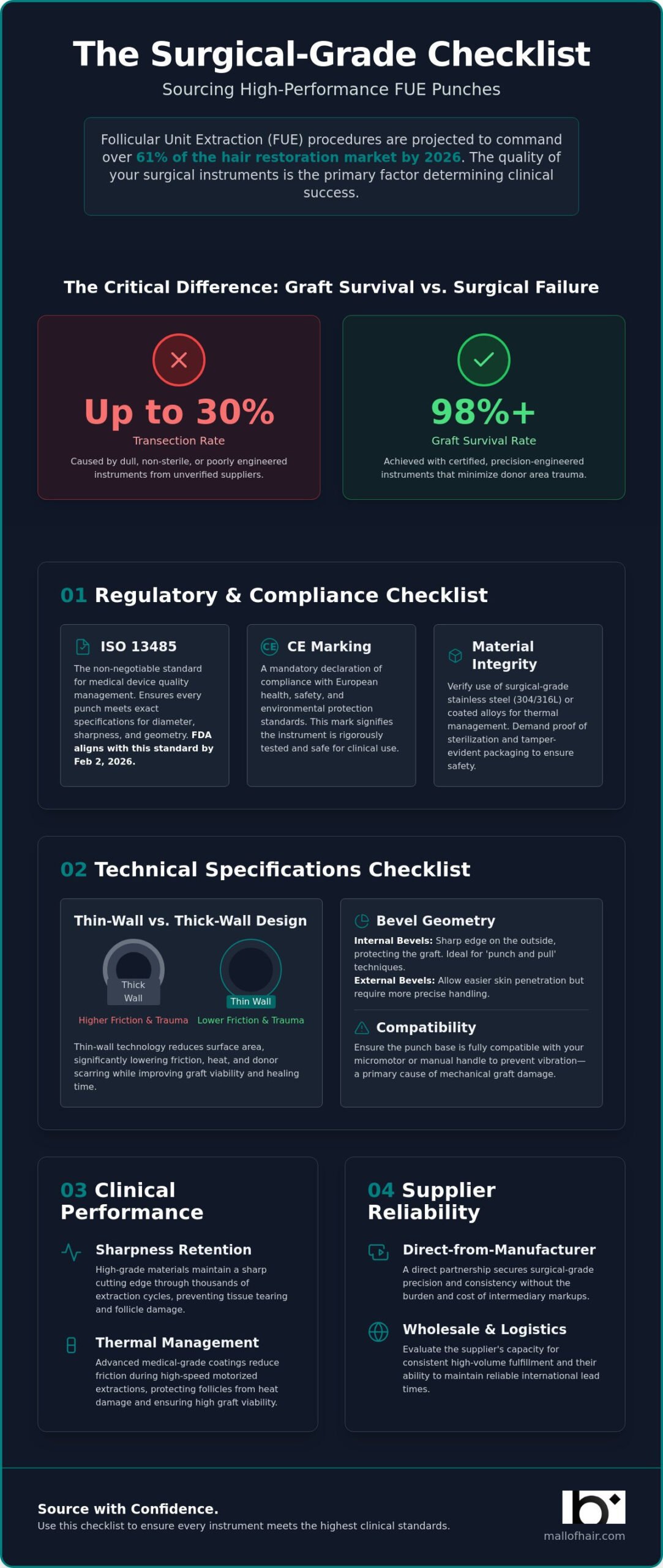
While FUE procedures are projected to command over 61% of the hair restoration market in 2026, the difference between a 98% graft survival rate and surgical failure often comes down to a fraction of a millimeter in tool geometry. You likely recognize that selecting an FUE punch supplier is no longer just a procurement task; it’s a critical clinical decision that dictates donor area trauma and long-term patient satisfaction. The risk of receiving dull, non-sterile, or poorly engineered instruments from unverified global sources can lead to transection rates as high as 30%. This is an unacceptable outcome for any high-performance clinic.
This article provides a comprehensive, surgical-grade checklist to verify quality, compliance, and performance when sourcing instruments online. You’ll learn how to navigate the 2026 regulatory landscape, including the FDA’s alignment with ISO 13485 standards effective as of February 2, 2026. We’ll examine the essential technical benchmarks for micro-punch diameters and the logistical requirements for establishing a reliable, high-volume wholesale partnership with a certified manufacturer.
Key Takeaways
- Identify the critical certifications like ISO 13485 and CE marking that guarantee your instruments meet 2026 international medical device standards.
- Understand how thin-wall designs and specific bevel geometries reduce donor site trauma while significantly improving graft survival rates.
- Evaluate your FUE punch supplier based on their capacity for consistent wholesale fulfillment and their ability to maintain reliable international lead times.
- Learn to assess technical factors like sharpness retention and thermal management to prevent follicle damage during high-speed motorized extractions.
- Discover the strategic advantages of a direct-from-manufacturer partnership to secure surgical-grade precision without the burden of intermediary markups.
The Regulatory Checklist: Verifying Medical Grade Standards
Procuring surgical instruments online requires a shift from retail-focused browsing to clinical vetting. A reputable FUE punch supplier must demonstrate adherence to international quality management systems to ensure instrument performance and patient safety. In the context of Follicular Unit Extraction (FUE), where precision is measured in microns, regulatory compliance is the only objective measure of a manufacturer’s technical capability.
Why ISO 13485 is Non-Negotiable
ISO 13485 is the international standard for medical device manufacturing quality management. This certification isn’t just a label; it’s a comprehensive framework that governs every stage of production. For a clinic, it’s a guarantee that every FUE punch produced meets exact specifications for diameter and sharpness. Without this framework, clinics face the risk of inconsistent tool geometry. This inconsistency leads to unpredictable graft survival rates and increased donor area trauma. A manufacturer following these protocols ensures that the 0.8mm punch you order today is identical to the one you receive months later.
CE Marking serves as a mandatory declaration that the product complies with European health, safety, and environmental protection standards. For global clinics, this mark signifies that the instrument is safe for clinical use and meets rigorous testing criteria. When vetting a potential FUE punch supplier, clinics must demand proof of these certifications to mitigate legal and clinical risks. These documents serve as your primary defense against substandard instruments that jeopardize patient outcomes.
Material Integrity: Stainless Steel vs. Coated Alloys
Surgical-grade stainless steel, specifically 304 or 316L, remains the benchmark for high-volume extractions. These materials provide the necessary tensile strength to maintain a sharp edge through thousands of cycles. However, 2026 standards prioritize thermal management. Advanced medical-grade coatings on stainless steel alloys reduce friction during motorized harvesting. This is vital for protecting the follicle from thermal damage and ensuring high graft viability. Biocompatibility is equally critical; instruments must be non-reactive to prevent inflammatory responses in the donor area.
Beyond the material itself, the integrity of the sterilization process is paramount. Online shipments must arrive in medical-grade, tamper-evident packaging that maintains a sterile barrier until the point of use. This prevents contamination during transit and ensures the instrument is ready for the surgical suite immediately upon arrival. Always verify that the supplier provides clear material declarations and sterilization logs to confirm the instruments meet surgical-grade requirements.
Technical Specifications Checklist: Geometry and Precision
Precision in follicular extraction is dictated by the physical laws of friction and displacement. A professional FUE punch supplier must provide more than just a list of diameters; they must offer instruments with exacting tolerances. These tools fall under the FDA classification for manual surgical instruments, and their specific geometry directly influences the clinical outcome and the rate of graft survival.
The Science of Thin-Wall Punches
Wall thickness is a primary factor in tissue resistance. Traditional designs utilized thicker walls for durability, but this often resulted in higher transection rates and visible donor scarring. Modern high-precision designs utilize ‘thin-wall’ technology. This reduces the surface area that enters the scalp, significantly lowering friction and heat generation. When you explore our technical FUE punch range, you’ll see how these designs facilitate a cleaner incision. This leads to faster healing and higher graft viability for the patient.
The choice between internal and external bevels also impacts your surgical flow. Internal bevels protect the graft by keeping the sharp edge on the outside of the lumen. This is particularly effective for surgeons using a ‘punch and pull’ technique. Conversely, external bevels allow for easier skin penetration but require a steadier hand to avoid follicle damage. You must also verify that the punch base is compatible with your specific micromotor or manual handle. Incompatibility leads to vibration, which is a primary cause of mechanical graft damage during extraction.
Selecting the Right Sizes for Your Patient Base
A versatile inventory is essential for any high-volume clinic. Your FUE punch supplier should offer a range of sizes that match diverse patient ethnicities and hair characteristics:
- 0.8mm punches: These are the gold standard for micro-FUE. They’re best for fine hair and patients who demand minimal visible scarring in the donor area.
- 0.9mm punches: This is the versatile standard. It’s suitable for the majority of Caucasian hair types and provides a balance between ease of use and donor preservation.
- 1.0mm and larger punches: These are reserved for coarse hair or multi-follicular units. Using a punch that’s too small for these units increases the risk of transecting one of the follicles in the group.
Diameter accuracy isn’t negotiable. A deviation of even 0.05mm can change how the tool interacts with the skin and the underlying tissue. Ensure your manufacturer guarantees these tolerances through rigorous quality control. If you’re unsure which geometry suits your specific extraction technique, you can reach out for a technical consultation with our engineering team.
Supplier Reliability & Global Logistics Checklist
Establishing a resilient supply chain is as critical to a clinic’s success as the surgical technique itself. A reliable FUE punch supplier must offer more than just high-quality steel; they must provide logistical certainty and technical support. When reviewing a comprehensive review of FUE punches, it’s clear that instrument availability directly impacts clinic operational efficiency and patient scheduling. High-volume centers can’t afford the clinical risks associated with inconsistent tool batches or unexpected shipping delays.
The Istanbul Advantage: Why Source from Turkey?
Istanbul has solidified its position as the global epicenter for hair restoration innovation. This concentration of clinical expertise has fostered a manufacturing environment where surgical tools are refined through constant feedback from world-leading practitioners. Turkish-manufactured instruments offer an exceptional cost-to-quality ratio, providing surgical-grade precision that often exceeds that of more expensive Western counterparts. Strategically located at the crossroads of Europe, Asia, and Africa, Istanbul serves as a premier hub for rapid global distribution. This geographic advantage ensures that clinics in the Americas or the EU receive their orders with significantly reduced transit times compared to other manufacturing centers.
Wholesale vs. Retail Sourcing
High-performance clinics must shift away from retail-based procurement to a wholesale model. Sourcing hair transplant instruments in bulk isn’t just about cost reduction; it’s about clinical consistency. Buying in large quantities ensures that your surgical team works with identical tools from the same production batch, eliminating subtle variances in sharpness or diameter that can occur between disparate retail orders. You should prioritize suppliers that offer ‘Clinic Kits’ which combine punches, sapphire blades, and forceps in a single, integrated package.
- Tiered Pricing: Ensure the supplier provides clear discounts for bulk orders to maximize your operational budget.
- Batch Consistency: Confirm that long-term contracts guarantee identical technical specifications across every shipment.
- Customs Documentation: Verify that the supplier provides all necessary medical device certifications to ensure smooth customs clearance in your specific region.
A vetted FUE punch supplier will also offer dedicated account management. Direct communication with a technical expert is essential for resolving surgical equipment queries or addressing urgent inventory needs. This level of support transforms a vendor relationship into a strategic partnership, allowing your clinic to focus on patient outcomes rather than procurement logistics. Reliable lead times and transparent shipping schedules are the foundation of this professional trust.
Clinical Performance Checklist: Sharpness and Survival
Clinical success in hair restoration is determined by the instrument’s ability to maintain its integrity throughout the entire procedure. A premium FUE punch supplier provides tools that don’t just perform well during the first few extractions but maintain surgical-grade sharpness for the duration of a high-volume session. When a punch begins to dull, the surgeon must increase pressure. This leads to higher transection rates and unnecessary trauma to the surrounding tissue. In a typical 2,000-graft session, the consistency of the cutting edge is the primary variable in ensuring uniform graft quality.
Testing Sharpness in a Clinical Setting
Upon receiving an online order, clinics should implement a standardized protocol to evaluate the edge quality of their instruments. Use a high-power surgical microscope or loupes with at least 10x magnification to inspect the punch tip. A high-quality edge should appear smooth and uniform with no visible burrs, nicks, or reflective irregularities. If the edge appears jagged under magnification, it will likely cause tissue dragging rather than a clean incision. For a deeper look at material standards, consult our guide on FUE Punch Manufacturer: Selecting the Best Surgical Grade.
Beyond visual inspection, monitor the tool’s performance during the initial extractions of a procedure. A sharp punch should penetrate the skin with minimal resistance. If you notice a “popping” sound or see the skin tenting significantly before the incision, the instrument lacks the necessary sharpness for high-density extraction. High-performance stainless steel alloys are designed to retain this edge through hundreds of cycles, reducing the need for frequent tool changes mid-surgery.
Maximizing Graft Survival
Graft survival depends heavily on protecting the integrity of the sebaceous gland and the follicular bulb. Precision-engineered punches minimize the “dead space” between the inner wall and the follicle, preventing mechanical torsion. This is especially critical when using motorized systems where heat generation is a constant risk. Excessive heat can lead to thermal damage, effectively killing the graft before it is even harvested. Your FUE punch supplier should provide data on how their tool geometry and coatings manage friction to mitigate these risks.
- Depth Control: Ensure your punches allow for precise depth matching based on the patient’s scalp thickness to avoid deep tissue injury.
- Thermal Management: Look for thin-wall designs that dissipate heat rapidly during high-speed rotation.
- Ergonomic Design: Tools must be balanced to reduce surgeon hand fatigue during 8-hour procedures, as steady hands are vital for graft survival.
The surgical process doesn’t end with extraction. The health of the donor and recipient areas must be maintained through evidence-based protocols. For more information on protecting your clinical results, read our Post Transplant Hair Care Products: The 2026 Clinical Guide. If you require specific technical specifications for your clinic’s motorized systems, you can request technical performance data from our engineering team.
The Final Selection: Why Bind Pharma is the Secure Choice
Selecting a reliable FUE punch supplier is the final step in securing your clinic’s surgical standards. Bind Pharma represents the intersection of Istanbul’s clinical heritage and modern manufacturing precision. By sourcing directly from our ISO 13485 certified facility, you eliminate the markups associated with third-party distributors. This direct access ensures that you receive surgical-grade instruments that have passed through a rigorous quality management system before reaching your surgical suite.
Our catalog extends beyond follicular extraction to provide a complete surgical suite. We offer high-precision DHI implanter pens, sapphire blades, and specialized forceps. This vertically integrated ecosystem ensures that every tool in your procedure is engineered to work in harmony. When your extraction punches, implantation pens, and post-op care products come from a single, verified source, you achieve a level of clinical consistency that retail sourcing cannot match. Our Istanbul-based production hub serves as a global center for these innovations, supplying elite clinics across Europe, Asia, and the Americas.
Beyond the Punch: A Strategic Partnership
We don’t just manufacture instruments; we provide the expertise required to use them at the highest level. Through the Aesthetic Academy, we offer professional training that bridges the gap between procurement and clinical excellence. For clinics looking to scale their operations rapidly, we also provide professional hair transplant teams to support high-volume growth. This holistic approach makes Bind Pharma a long-term strategic partner rather than a simple vendor. Our R&D is driven by actual clinical feedback, ensuring that every design update solves real-world surgical challenges.
How to Place Your First Order
Navigating our global wholesale process is designed for clinical efficiency. You can begin by reviewing our comprehensive online catalog to identify the specific geometries, wall thicknesses, and diameters required for your patient demographic. Once you’ve identified your requirements, the next step is to request a wholesale quote tailored to your clinic’s volume. Our dedicated account managers provide full support throughout the shipping and customs process, ensuring that your medical-grade instruments arrive with the necessary documentation for rapid clearance.
- Request a Quote: Submit your clinical requirements through our digital platform for tiered pricing.
- Technical Support: Consult with our engineering team to ensure compatibility with your existing micromotors.
- Logistics Coordination: Receive real-time updates on your international shipment from our Istanbul hub.
Securing your supply chain with a manufacturer-direct relationship is the most effective way to maintain 98% graft survival rates and minimize donor trauma. Contact Bind Pharma for a customized wholesale quote today and elevate your clinic’s surgical performance with instruments engineered for excellence.
Securing Clinical Excellence Through Strategic Sourcing
Transitioning to a high-performance surgical model requires more than just clinical skill; it demands a supply chain built on technical integrity. You’ve seen how verifying ISO 13485 standards and optimizing punch geometry can significantly reduce transection rates while improving graft survival. Selecting a verified FUE punch supplier isn’t merely a logistical task; it’s a fundamental commitment to your patients’ long-term results and safety. Quality instruments are the silent partners in every successful hair restoration procedure.
Bind Pharma stands as an ISO 13485 certified manufacturer, providing global wholesale shipping and Aesthetic Academy trained precision to elite clinics worldwide. By eliminating intermediaries and sourcing directly from our Istanbul production hub, you ensure that every instrument meets the exact tolerances required for modern hair restoration. This strategic alignment between manufacturer and practitioner is the foundation of consistent surgical excellence in an increasingly competitive market.
Secure Your Clinic’s Supply: Browse Bind Pharma’s ISO-Certified FUE Punches
We’re ready to support your clinic’s growth with the precision and reliability your team deserves for every procedure.
Frequently Asked Questions
What is the most important factor when buying FUE punches online?
Verifying the manufacturer’s regulatory compliance and technical specifications is the most critical step. A reputable FUE punch supplier must provide accessible documentation for ISO 13485 certification and CE marking. These credentials ensure the instruments are produced under strict quality management systems. This directly impacts the consistency of the punch diameter and the sharpness of the cutting edge, which are vital for successful clinical outcomes.
How do I know if an FUE punch is truly surgical-grade?
True surgical-grade instruments are accompanied by detailed material declarations, typically specifying 304 or 316L stainless steel. These specific alloys offer the necessary corrosion resistance and tensile strength required for medical use. You should also look for medical-grade coatings designed to reduce friction and heat. Legitimate manufacturers will provide these technical details and sterilization protocols to confirm the instrument’s suitability for a sterile surgical environment.
Why should I choose an ISO 13485 certified supplier?
ISO 13485 certification is the definitive international benchmark for medical device quality management. It guarantees that the manufacturer follows standardized production processes to ensure product safety and clinical effectiveness. For your clinic, this means receiving instruments with predictable performance and precise tolerances. It minimizes the risk of complications caused by substandard tool geometry or inconsistent manufacturing batches that often plague uncertified suppliers.
Can I buy FUE punches in bulk for my clinic?
High-volume clinics should prioritize an FUE punch supplier that offers tiered wholesale pricing and bulk fulfillment capabilities. Buying in bulk ensures that your surgical team utilizes instruments from the same production lot, which maintains technical consistency across different procedures. Professional manufacturers often provide integrated ‘Clinic Kits’ that combine punches with other essential tools like sapphire blades and DHI pens to streamline your procurement process.
What are the standard FUE punch sizes for most procedures?
Standard punch sizes typically range from 0.8mm to 1.0mm depending on the patient’s specific hair characteristics. 0.8mm punches are the gold standard for micro-FUE to minimize visible donor scarring. 0.9mm is considered the versatile industry standard for the majority of hair types. 1.0mm punches are generally reserved for coarse hair or multi-follicular units where a larger lumen is necessary to prevent mechanical transection of the follicles.
How does shipping work for medical instruments from Turkey?
Shipping from Istanbul utilizes a strategic global logistics network to reach major markets in Europe, Asia, and the Americas rapidly. Professional suppliers provide all necessary medical device documentation to ensure smooth customs clearance in the destination country. Transit times are optimized through partnerships with international couriers. This ensures that sterile instruments are delivered in tamper-evident packaging while maintaining their structural integrity throughout the entire transit process.
Is there a difference between manual and motorized FUE punches?
The primary difference lies in the base design and the instrument’s thermal management capabilities. Motorized punches are engineered to withstand high-speed rotation and must feature thin-wall designs to dissipate heat quickly. Manual punches focus on ergonomic grip and tactile feedback for the surgeon’s hand. You must verify that the punch base is specifically compatible with your clinic’s micromotor system to prevent mechanical vibration, which is a leading cause of graft damage.
What is the lifespan of a high-quality FUE punch?
The lifespan of a punch is measured by its sharpness retention during a single procedure. Most high-quality FUE punches are designed as single-use instruments to ensure maximum sharpness and absolute sterility. A premium punch should maintain its cutting edge throughout a 2,000 to 3,000 graft session. Reusing punches significantly increases the risk of follicle dragging, thermal damage, and cross-contamination, which compromises the final hair restoration result.