A single micron of inconsistency in a surgical tip is often the difference between a successful graft and a permanent transection. In a global hair transplant market now valued at over $11 billion, clinics can’t afford the operational drag caused by dull or uncertified instruments. Selecting a reliable FUE punch manufacturer is no longer just a procurement task; it’s a strategic decision that directly impacts your surgical outcomes and graft survival rates. Professional excellence begins with the tools that interface with the patient, and any compromise in manufacturing quality quickly translates to diminished clinic reputation.
You’ve likely dealt with the frustration of supply chain delays or punches that lose their edge mid-procedure. It’s a common pain point that compromises both patient results and your bottom line. This guide will help you master the technical and regulatory criteria for sourcing precision instruments in 2026. We’ll explore how the FDA’s Quality Management System Regulation, which became effective in February 2026, impacts your selection process. We also preview how bulk partnerships with ISO 13485 certified manufacturers can reduce your cost-per-procedure while maintaining the absolute precision required for modern hair restoration.
Key Takeaways
- Understand why manufacturing tolerances of ±0.01mm are essential for maintaining graft integrity and reducing transection rates during high-speed extraction.
- Learn to verify ISO 13485 certification to ensure your supplier meets the harmonized 2026 global regulatory standards for medical device safety.
- Discover how to evaluate an FUE punch manufacturer based on their scalable production capacity and ability to provide custom tip geometries.
- Identify the critical performance differences between sharp, blunt, and serrated tips to optimize extraction paths for diverse patient skin types.
- Recognize the operational and clinical advantages of sourcing instruments made from traceable, medical-grade stainless steel for superior edge retention.
The Critical Role of an FUE Punch Manufacturer in Modern Hair Restoration
The success of a hair transplant procedure depends heavily on the initial contact between the instrument and the donor tissue. In the context of Follicular Unit Extraction, the punch serves as the primary interface between the surgeon and the patient’s scalp. It isn’t merely a cutting tool; it’s a precision instrument designed to isolate delicate follicular units without compromising their biological viability. Every mechanical interaction during extraction carries a risk of trauma, making the quality of the instrument a non-negotiable factor in surgical planning.
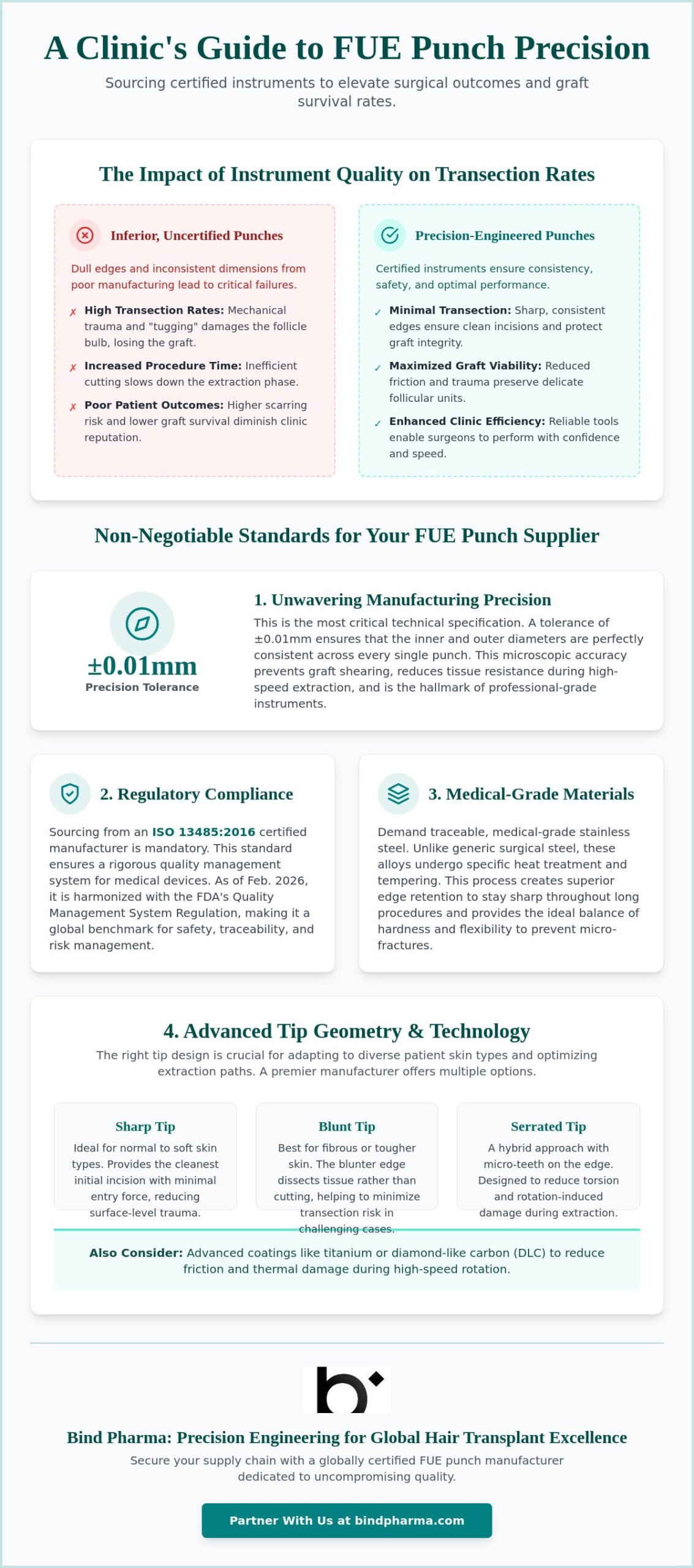
Manufacturing tolerances are the silent arbiters of graft integrity. When an FUE punch manufacturer operates with a precision variance of ±0.01mm, they ensure that the internal diameter remains consistent across every unit in a batch. This level of accuracy is vital during high-speed extraction, where even a microscopic deviation can lead to graft shearing or unnecessary tissue resistance. These tolerances distinguish professional-grade equipment from generic alternatives that often lack the calibration necessary for high-stakes medical applications.
Material science plays an equally critical role in instrument performance. There’s a significant distinction between general-purpose surgical steel and the medical-grade alloys required for high-performance punches. True medical-grade steel undergoes specific heat treatment and tempering processes to achieve a balance between hardness and flexibility. This ensures the edge remains sharp throughout the procedure while resisting the micro-fractures that can occur with inferior metals. An FUE punch manufacturer is a strategic partner in clinical success, providing the foundational reliability that surgeons need to achieve consistent, repeatable results.
The Evolution of Extraction Technology
Extraction technology has transitioned rapidly from manual hand-held tools to sophisticated, micromotor-compatible instruments. Modern manufacturing processes now allow for significantly thinner walls, which reduce the total surface area of the incision. This advancement minimizes the physical footprint left in the donor area, promoting faster healing and less visible scarring. Additionally, the shift toward specialized coatings, such as titanium or diamond-like carbon, helps reduce friction and thermal damage during high-speed rotation. These innovations ensure that the follicle remains in a stable environment from the moment of incision until extraction.
Why Your Choice of Supplier Dictates Your Transection Rate
The relationship between punch sharpness and transection rates is direct and undeniable. When a punch is dull or inconsistently manufactured, it causes “tugging” or “burring” as it enters the skin. This mechanical stress can easily damage the bulb of the hair follicle, leading to a permanent loss of the graft. Inconsistent depth control is another byproduct of poor manufacturing; if a punch doesn’t seat correctly in the handpiece or micromotor, the surgeon loses the tactile feedback required for precision. Ultimately, poor-quality punches lead to lower graft survival rates, which can devastatingly impact a clinic’s reputation and long-term economic viability.
Manufacturing Standards: Why ISO 13485 and Medical-Grade Materials Matter
Adherence to international quality standards is the only way to ensure the safety and efficacy of surgical instruments in 2026. The most critical benchmark is ISO 13485:2016, which governs the design and manufacture of medical devices. As of February 2, 2026, the FDA’s Quality Management System Regulation officially harmonized with this standard. This alignment means that any global FUE punch manufacturer must maintain a rigorous quality management system that prioritizes risk assessment and consistent production cycles. For a clinic, sourcing from a certified manufacturer isn’t just about quality; it’s about meeting the legal requirements for medical device usage in a highly regulated industry.
Traceability of raw materials is another cornerstone of professional manufacturing. Every batch of high-grade stainless steel must be accompanied by documentation that tracks its metallurgical composition from the forge to the finished tool. This transparency prevents the use of recycled or inferior alloys that might fail under the stress of high-speed rotation. A comprehensive review of FUE systems confirms that the structural integrity of the punch directly dictates the clean nature of the follicular incision. Premium punches are manufactured in cleanroom environments to prevent microscopic contaminants from embedding in the metal surface during the sharpening process.
Sterilization readiness is a non-negotiable feature for modern surgical tools. Premium FUE punches are designed to withstand repeated autoclave cycles without losing their structural integrity or edge sharpness. This durability is achieved through advanced heat treatment processes that stabilize the steel at a molecular level. Clinics seeking to verify these standards should evaluate the FUE punch specifications provided by certified suppliers to ensure they meet these rigorous clinical demands.
The Metallurgy of Precision: Stainless Steel vs. Titanium
Most high-performance punches utilize 300-series stainless steel due to its exceptional corrosion resistance and ability to hold a razor-sharp edge. While “surgical grade” is often cited as a marketing term, it should be considered the bare minimum requirement for any medical instrument. Some manufacturers offer titanium-coated variants, which provide superior biocompatibility and significantly reduce friction during the extraction phase. This reduction in friction is vital for preventing thermal damage to the graft, ensuring that the follicle remains viable for implantation.
Regulatory Compliance and Export Documentation
Navigating the global supply chain requires a thorough understanding of regulatory markings such as the CE mark and FDA registration. These certifications indicate that the instruments have passed stringent safety tests and are approved for clinical use in their respective regions. Reliable manufacturers provide a Certificate of Analysis (CoA) for every wholesale batch, confirming that the technical specifications match the advertised standards. Bind Pharma maintains these global standards from its Istanbul facility, ensuring that every instrument shipped meets the high expectations of international hair restoration clinics.
Technical Specifications: Evaluating Tip Geometry and Coating Technologies
Precision in hair restoration depends on the specific technical configuration of the punch tip. An FUE punch manufacturer must offer a diverse range of diameters, typically from 0.7mm to 1.0mm, to accommodate varying follicular unit sizes and densities. Selecting the correct size is a clinical necessity. A 0.8mm punch might be ideal for single-hair units, while a 1.0mm tip is often required for multi-hair grafts to avoid transection. Beyond diameter, the beveling of the tip, whether internal or external, dictates the extraction path. Internal beveling directs the cutting edge away from the follicle, providing a safety margin that is essential during deep penetrations.
Tip Geometry and Tissue Interaction
Surgeons must choose between sharp, blunt, or serrated geometries based on the patient’s skin characteristics. Sharp punches offer minimal resistance and are preferred for tough, fibrotic scalps where penetration must be swift. In contrast, the history of FUE instruments shows a significant shift toward serrated and hybrid designs to reduce the surface area contact between the tool and the tissue. Serrated edges distribute mechanical force more evenly, which significantly lowers heat generation and minimizes the risk of thermal damage to the graft. Flared walls are another innovation, providing extra space for the bulb of the follicular unit, which prevents mechanical compression during the upward stroke of the extraction.
Advanced Coatings: Beyond Aesthetic Appeal
Modern coating technologies provide functional advantages that extend far beyond visual identification. Gold-plated FUE punches, for instance, offer superior conductivity and visibility against the scalp, allowing for better depth perception under surgical lights. Non-stick coatings are equally vital in high-volume cases, as they prevent tissue adhesion and clogging that can slow down the procedure. When evaluating an FUE punch manufacturer, clinics should also inquire about the Rockwell hardness rating of the instruments. A higher rating on the Rockwell scale indicates better edge retention, ensuring the punch doesn’t become dull after only a few hundred extractions. This durability is critical for maintaining a consistent extraction rhythm and ensuring that the final graft of the day is as clean as the first.
Strategic Sourcing: How to Vet a Global Wholesale Supplier
Strategic sourcing in the hair restoration industry requires a shift from simple procurement to long-term operational planning. When you evaluate an FUE punch manufacturer, the first metric to analyze is their industrial scalability. A supplier capable of producing 10,000+ units monthly demonstrates the infrastructure necessary to support global clinic chains and prevent stockouts during peak periods. High-volume capacity usually indicates a mature manufacturing process where quality control is automated and repeatable, rather than dependent on manual labor. This consistency is what protects your clinic from the “dull batch” syndrome that can derail a surgical schedule.
Customization is the second pillar of a successful partnership. Precision isn’t a one-size-fits-all concept in 2026. You need to know if the manufacturer can adjust bevel angles or internal diameters to match your specific extraction protocols. A supplier that offers technical flexibility shows they understand the nuances of different hair types and ethnic scalp characteristics. Beyond the product itself, review the logistics and post-sale support. Shipping times from major manufacturing hubs like Turkey to the US or EU should be predictable, often taking less than five business days through established medical export channels. Reliable manufacturers provide technical documentation and guidance on instrument maintenance to extend the life of your surgical assets.
Why Istanbul is the Global Hub for Hair Transplant Manufacturing
Istanbul has solidified its position as the global epicenter for hair restoration technology. With the global hair transplant market valued at over $11 billion in 2026, the Turkish medical export ecosystem has evolved to meet massive demand. This proximity to the world’s highest concentration of clinics creates a unique feedback loop. Manufacturers refine their tools based on thousands of daily procedures, ensuring that every instrument meets the practical needs of active surgeons. Turkish manufacturers like Bind Pharma offer a strategic advantage by combining competitive production costs with the rigorous ISO 13485 standards required for international medical device compliance. This allows clinics to access premium instruments without the inflated premiums often found in other regions.
A Checklist for Wholesale Buyers
Before committing to a high-volume contract, use a rigorous vetting process to ensure the supplier meets your clinical standards. Request a sample batch for clinical testing to verify edge retention over a full 2,000-graft case. It’s also vital to evaluate the mechanical compatibility between the punch and your Fue Micromotor. A loose or vibrating fit increases the risk of transection and creates unnecessary noise during the procedure. Finally, assess the manufacturer’s broader range. Sourcing your Sapphire Blade, DHI Implanter Pen, and Forceps from a single certified partner simplifies your supply chain and ensures a unified standard of precision across your surgical kits. Clinics looking to stabilize their supply chain should review our 2026 checklist for vetting a qualified FUE punch supplier before committing to any wholesale agreement, and then contact an FUE punch manufacturer that specializes in high-volume, precision-grade medical exports.
Bind Pharma: Precision Engineering for Global Hair Transplant Excellence
Bind Pharma operates as a cornerstone of the medical device industry in Istanbul, Turkey. As an ISO 13485 certified manufacturer, the company bridges the gap between metallurgical precision and clinical application. While many suppliers focus solely on distribution, Bind Pharma maintains direct control over the production of its entire instrument range. This portfolio includes high-performance FUE punches, DHI implanter pens, and sapphire blades. By centralizing operations in a global hair restoration hub, the brand ensures that every tool is tested against the rigorous demands of high-volume clinical environments. This localized expertise allows for a rapid feedback loop between surgeons and engineers, resulting in tools that solve real-world surgical challenges.
The technical superiority of Bind Pharma instruments stems from a commitment to zero-tolerance engineering. Every FUE punch manufacturer must prioritize consistency, but Bind Pharma implements multi-stage quality control protocols that analyze every wholesale batch for edge sharpness and dimensional accuracy. State-of-the-art production facilities allow for the creation of ultra-thin-walled punches that minimize tissue trauma during extraction. For elite surgeons, the ability to request custom bevel angles or specific diameters provides a level of surgical control that generic suppliers cannot match. This dedication to precision ensures that graft survival remains the primary objective of every tool produced in the Istanbul facility.
The Bind Pharma Manufacturing Advantage
The manufacturing process at Bind Pharma utilizes high-grade stainless steel and advanced coating technologies to ensure long-term durability. Each instrument is designed to withstand the rigors of repeated sterilization without compromising its structural integrity. The company’s FUE punch manufacturer status is backed by a global supply chain that serves over 210 clinics across more than 20 countries. This scale allows for competitive wholesale pricing while maintaining the European quality standards that modern clinics demand. Every batch undergoes rigorous testing to ensure that the “punch-to-micromotor” fit is seamless, reducing mechanical vibration and noise during the procedure.
Beyond the Tool: A Holistic Clinical Partnership
A superior instrument only reaches its full potential in the hands of a skilled professional. Bind Pharma distinguishes itself by offering a holistic clinical partnership through the Aesthetic Academy. This institution provides specialized training that ensures technicians and surgeons master the nuances of using precision tools. Additionally, the company provides professional hair transplant teams to clinics worldwide, bridging the global talent gap. This synergy between manufacturing excellence and educational support creates a unique ecosystem where clinical outcomes are optimized through both hardware and human expertise. You don’t just receive a shipment of tools; you gain access to a global network of surgical proficiency. It’s time to stabilize your supply chain and elevate your surgical standards. Partner with Bind Pharma for your surgical instrument needs and secure the future of your clinical results.
Securing the Future of Surgical Precision in Hair Restoration
Professional excellence in hair restoration is inseparable from the technical integrity of the instruments used during extraction. As the global market expands, the distinction between standard tools and precision-engineered equipment becomes the primary driver of clinic success. Selecting a specialized FUE punch manufacturer ensures that your surgical team operates with consistent tip geometry and superior edge retention. These factors are critical for minimizing transection rates and maximizing graft survival in high-volume environments.
Bind Pharma provides a comprehensive solution by combining industrial-scale production with rigorous ISO 13485 certification. By supplying clinics in more than 50 countries and offering specialized training through our Aesthetic Academy, we serve as a strategic partner rather than a mere supplier. Our commitment to metallurgical precision and regulatory transparency protects your clinic’s reputation and operational efficiency. Explore Bind Pharma’s ISO-Certified FUE Punch Collection to secure the future of your surgical performance. Elevating your clinic’s standards begins with the tools you trust.
Frequently Asked Questions
What is the standard FUE punch size for most hair transplant procedures?
Standard punch sizes typically range from 0.8mm to 1.0mm for the majority of hair restoration cases. A 0.8mm punch is frequently utilized for standard follicular units, while 0.7mm is reserved for fine, single-hair grafts. Selecting the correct diameter is a clinical necessity to prevent mechanical transection of the follicle bulb during the extraction process.
How many times can a high-quality FUE punch be reused?
High-quality punches are generally designed for single-use to guarantee absolute sharpness and patient safety. While premium medical-grade steel can withstand several autoclave cycles, the microscopic edge degradation after the first procedure can increase tissue resistance. Most professional clinics prioritize superior graft survival by using a fresh instrument for every surgical case to maintain peak performance.
What is the difference between a manual FUE punch and a micromotor punch?
A manual punch is operated by hand for maximum tactile control, whereas a micromotor punch is designed for high-speed rotation in a motorized handpiece. Micromotor punches require precise shank dimensions to ensure a stable fit and reduce vibration. While motorized extraction increases procedure speed, it necessitates a high-precision tool to manage heat generation and prevent thermal damage to the grafts.
Why is ISO 13485 certification important for a hair transplant instrument manufacturer?
ISO 13485 certification confirms that an FUE punch manufacturer adheres to a rigorous quality management system specifically for medical devices. This certification is a legal requirement for international export and ensures every batch meets harmonized 2026 safety standards. It provides clinics with a verifiable guarantee of manufacturing consistency, material traceability, and adherence to global regulatory requirements.
How do I choose between a sharp and a serrated FUE punch?
Sharp punches are ideal for patients with tough or fibrotic scalps where swift penetration is required with minimal force. Serrated punches are preferred for reducing the surface area contact between the tool and the tissue, which significantly lowers heat generation. The choice depends on the surgeon’s specific technique and the skin characteristics of the patient’s donor area.
Can Bind Pharma provide custom-sized FUE punches for specialized clinics?
Bind Pharma offers extensive customization options to support specialized clinical protocols and unique surgical requirements. Our manufacturing facility in Istanbul can produce custom diameters, specific bevel angles, and specialized coatings for elite surgeons. This technical flexibility is a core advantage of partnering with a direct FUE punch manufacturer that controls the entire production cycle.
What are the benefits of sourcing FUE punches from Turkey?
Sourcing from Turkey provides access to the world’s most active feedback loop for hair restoration technology. Istanbul manufacturers combine competitive production costs with the high quality standards required by thousands of international clinics. This proximity to a massive clinical market ensures that instruments are continuously refined based on real-world surgical data and the latest industry trends.
Do you offer bulk discounts for large hair restoration clinic groups?
Wholesale partnerships and bulk sourcing are central to our global distribution model for large clinic groups and surgical chains. We provide scalable supply solutions to ensure a consistent inventory of precision instruments while maintaining rigorous ISO-certified quality standards. These arrangements allow high-volume clinics to stabilize their supply chain and reduce operational costs without compromising surgical excellence.