
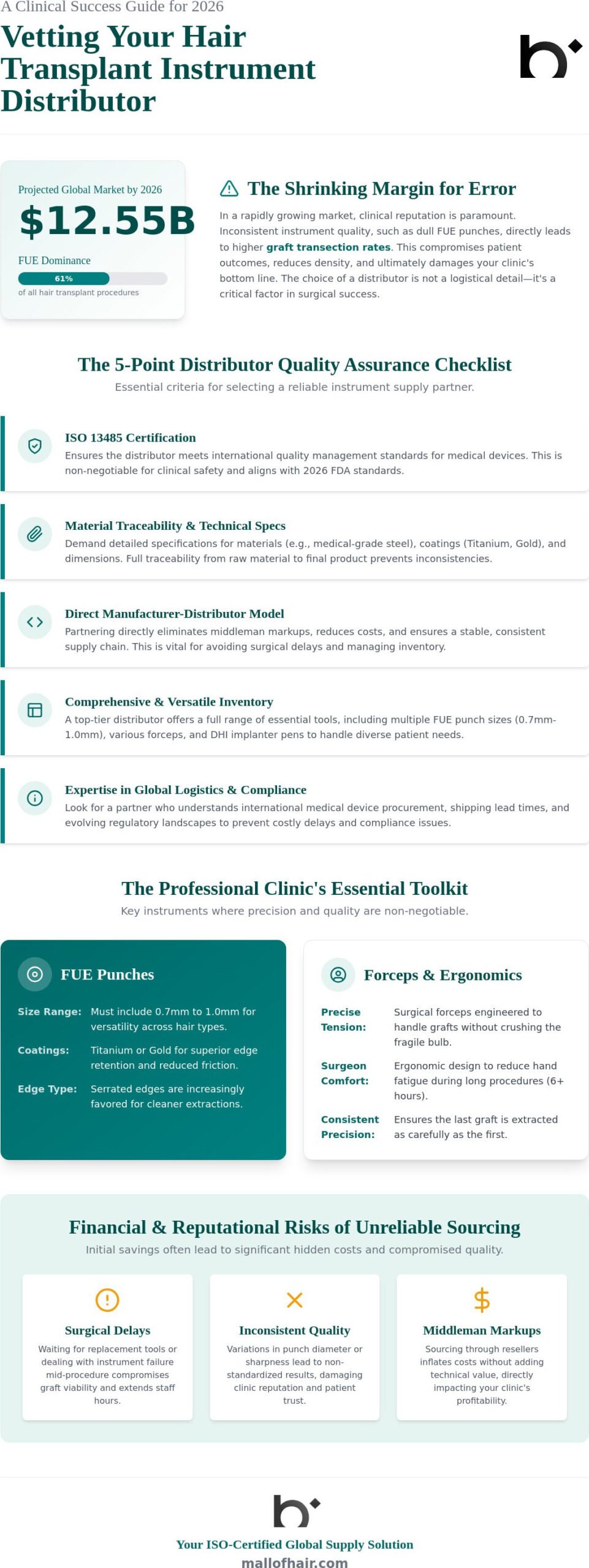
With the global hair transplant market projected to reach $12.55 billion in 2026, the margin for clinical error has never been thinner. While FUE procedures now account for over 61% of this global market, many clinic owners still struggle with inconsistent punch sharpness and graft transection rates that compromise patient outcomes. Selecting a reliable hair transplant instrument distributor isn’t just a logistics decision. It’s a critical factor in surgical success that directly impacts your clinic’s reputation and bottom line.
You’ve likely experienced the frustration of dull tools or delayed international shipments that disrupt your surgical schedule. This article provides a professional framework for vetting distributors to ensure you secure medical-grade tools that prioritize graft survival. We’ll examine the 2026 procurement checklist, focusing on the recent FDA alignment with ISO 13485 standards and the necessity of maintaining a consistent supply of 0.8mm to 0.9mm FUE punches. You’ll learn how to reduce per-procedure costs through direct manufacturer-distributor partnerships without sacrificing the technical quality your patients expect.
Key Takeaways
- Understand the direct correlation between instrument precision and follicle transection rates to maximize graft survival.
- Identify the technical specifications required for FUE punches and DHI implanter pens to maintain high-density placement standards.
- Learn the essential 5-point criteria for vetting a hair transplant instrument distributor, focusing on ISO 13485 certification and material traceability.
- Master the logistics of international medical device procurement, including 2026 regulatory compliance and global shipping lead times.
Why Your Choice of Hair Transplant Instrument Distributor Dictates Graft Success
Surgical excellence in hair restoration is a synergy between clinical skill and technical precision. For clinic owners, the selection of a hair transplant instrument distributor is a strategic decision that directly influences the follicle transection rate (FTR). When instruments lack the required micro-geometry or edge retention, the risk of graft damage increases during extraction. This technical failure leads to poor density and suboptimal patient satisfaction, which can damage a clinic’s reputation in a highly competitive market.
Vetting a hair transplant instrument distributor based on technical specifications rather than price alone is the hallmark of a high-performance clinic. Choosing a partner that understands the nuances of hair transplantation techniques ensures that your surgical team has access to tools that maintain their integrity throughout long procedures. Consistent tool sharpness reduces donor site trauma, which minimizes inflammatory responses and significantly speeds up patient recovery times.
The Impact of Instrument Precision on Patient Outcomes
The integrity of a hair follicle is incredibly fragile. Even minor mechanical trauma during the extraction phase can lead to graft death. High-quality surgical forceps for hair transplant are engineered to provide the exact tension needed to handle grafts without crushing the bulb. Tool ergonomics also play a vital role. Instruments designed with the surgeon’s comfort in mind reduce hand fatigue during six-hour FUE sessions, ensuring the last graft is extracted as precisely as the first. When tool geometry is flawed, the surgeon must compensate with increased force, which is a primary cause of accidental transection.
Financial Risks of Unreliable Sourcing
Budget-focused procurement often results in hidden operational costs that far outweigh the initial savings. Inferior tools lose their edge quickly, forcing surgeons to use more force or switch tools mid-procedure. These interruptions increase the per-procedure cost by extending staff hours and reducing room turnover. The primary risks of unreliable sourcing include:
- Surgical Delays: Waiting for replacement tools during a live procedure compromises graft viability.
- Inconsistent Quality: Variations in punch diameter lead to non-standardized results across different patients.
- Middleman Markups: Buying through resellers increases costs without adding technical value.
Utilizing a standardized hair transplant instrument set ensures that every technician operates with the same level of precision. By sourcing directly from a manufacturer-distributor, clinics secure a stable supply of FUE punches while eliminating unnecessary price inflation. For clinics in a growth phase, supply chain stability is more valuable than a one-time discount. Reliable sourcing prevents inventory gaps that lead to canceled surgeries and lost revenue.
The Essential Inventory Checklist: Must-Have Tools for Professional Clinics
Establishing a high-performance hair restoration center requires more than clinical expertise. It demands a standardized inventory of medical-grade tools that perform consistently under rigorous surgical conditions. A professional hair transplant instrument distributor acts as a strategic partner by ensuring that every component, from the micromotor to the smallest forceps, meets international quality benchmarks. For 2026, procurement must focus on material science and ergonomic efficiency to maintain a competitive edge in patient outcomes.
The FUE Extraction Toolkit
The extraction phase is the most critical stage for graft survival. Clinics should maintain a versatile range of FUE punch sizes, typically spanning from 0.7mm to 1.0mm. Smaller diameters are essential for fine hair and minimizing donor site scarring, while larger punches are necessary for multi-hair follicular units or curly hair types. Coating options like Titanium or Gold are not merely aesthetic; they provide superior edge retention and reduce friction during penetration. Serrated edges are increasingly favored for their ability to minimize skin resistance and reduce the torque applied to the graft. Surgical-grade stainless steel with a titanium-nitride coating represents the 2026 industry standard for FUE punch durability and biocompatibility.
Implantation and Incision Innovation
Precision implantation has evolved with the rise of DHI (Direct Hair Implantation) pens, which are now essential for ‘No-Shave’ procedures and high-density placement. These tools must be evaluated based on their plunger stability and needle sharpness. Many clinics now prefer a hybrid model using reusable pen bodies with single-use needles to balance cost and hygiene. For traditional FUE, sapphire blades have surpassed steel as the industry standard. Their ability to create micro-incisions with minimal tissue trauma results in faster healing and less postoperative edema. Because these instruments are used for invasive procedures, they are governed by FDA Class II medical device regulations, requiring strict adherence to manufacturing standards.
A comprehensive hair transplant instrument set is incomplete without specialized forceps and high-stability micromotors. Forceps with angled or straight designs must offer enough tactile feedback to handle grafts without crushing the bulb. Similarly, FUE micromotors must provide consistent RPM stability and superior heat dissipation to prevent thermal damage to the follicles. Finally, a reliable hair transplant instrument distributor should provide clinical-grade post-transplant hair care solutions to ensure the patient’s recovery is as successful as the surgery itself. If you’re looking to upgrade your clinic’s technical capacity, you can consult with our specialists regarding customized inventory solutions.
5-Point Quality Assurance Checklist for Vetting a Distributor
Vetting a hair transplant instrument distributor requires a methodical approach to ensure surgical safety and long-term operational efficiency. Clinic owners must look beyond polished catalogs and verify the technical infrastructure behind the products. A failure in the supply chain doesn’t just result in a lost shipment; it compromises the biological integrity of every graft your team extracts. To mitigate these risks, follow this 5-point professional framework during your next procurement cycle.
Decoding Medical Certifications
ISO 13485 is the non-negotiable benchmark for any serious medical supplier. It’s the gold standard for quality management systems in the medical device industry. As of February 2, 2026, the FDA’s Quality Management System Regulation (QMSR) has officially aligned with ISO 13485:2016. This alignment means that an ISO-certified distributor now satisfies the majority of global regulatory requirements, including most U.S. quality system mandates. When you’re evaluating ISO 13485 hair transplant instruments, you should verify the FDA medical device classification to ensure the tools meet Class II standards for safety and efficacy.
CE marking remains equally essential for international market access. It serves as a baseline for sterilization protocols and material safety. Don’t hesitate to request a manufacturer’s quality control report for bulk orders. A transparent distributor will provide documentation proving that every batch has undergone rigorous testing for edge sharpness and structural integrity.
Manufacturer vs. Reseller: The Strategic Difference
Choosing Mall of Hair as a direct manufacturer over a third-party reseller offers a significant advantage in quality consistency. Resellers often source from multiple factories to maintain stock; this leads to batch-to-batch variations in punch sharpness or handle weight. A direct manufacturer maintains a closed feedback loop between the surgical theater and the production line. This allows for rapid iterations based on surgeon feedback. For a deeper analysis of these dynamics, refer to our guide on finding a FUE punch manufacturer to understand how precision is maintained at scale.
Material traceability is the third pillar of quality assurance. You must confirm that the distributor uses certified surgical-grade stainless steel or titanium. Ask for material mill certificates to prevent the use of cheap alloys that dull quickly and increase the risk of patient sensitivity. Fourth, evaluate customization capabilities. A high-tier distributor can produce specific punch sizes or custom handle designs that fit your team’s specific ergonomic needs. Finally, review their clinical support. Reliable partners provide technical guidance and training for their equipment; they ensure your staff understands the optimal RPM settings for micromotors or the correct sterilization cycles for reusable components.
Logistics and Global Compliance: Navigating Wholesale Sourcing in 2026
Operational efficiency in a modern clinic depends on a seamless supply chain that balances inventory availability with regulatory compliance. In 2026, the role of a hair transplant instrument distributor has expanded beyond some simple delivery. They must now act as a compliance partner, ensuring that every shipment adheres to the updated Medical Device Regulation (MDR) in Europe and the FDA’s Quality Management System Regulation (QMSR) in the United States. Navigating these complexities requires a distributor with a robust global logistics infrastructure, such as the B2B platform GetMedicalDevice, which facilitates access to specialized medical equipment from leading global manufacturers.
Optimizing Your Supply Chain
Istanbul has solidified its position as the global hub for hair transplant instrument manufacturing due to its unique intersection of industrial capacity and clinical expertise. High-volume clinics increasingly adopt “Just-in-Time” (JIT) inventory systems to reduce the capital tied up in stock while maintaining surgical readiness. This model relies heavily on a hair transplant instrument distributor that offers a “stock-on-hand” model rather than “made-to-order” production. When evaluating a supplier, their responsiveness and the sophistication of their technical support desk are critical indicators of their ability to handle urgent procurement needs. A reliable partner should provide real-time tracking and clear communication regarding lead times for bulk FUE punches and other essential consumables.
Packaging and Sterilization Standards
The technical integrity of surgical tools is often compromised during transit if medical-grade packaging standards are ignored. Instruments like sapphire blades and fine-tipped forceps require specialized cushioning to prevent micro-fractures or tip misalignment. Distributors must use puncture-resistant, sterile-barrier systems that maintain the shelf-life of disposable instruments. For clinics prioritizing sustainability and cost-efficiency, reusable tools are a viable option, provided they are designed for easy reprocessing. Reusable FUE punches must undergo a validated steam sterilization process in a medical-grade autoclave at 134 degrees Celsius for a minimum of 5 minutes to ensure absolute surgical sterility.
Handling import duties and medical device registration is another layer of wholesale sourcing that requires professional oversight. A distributor that provides pre-cleared documentation and material traceability reports reduces the risk of customs seizures or surgical delays. Balancing the savings of wholesale volume with the carrying costs of inventory is a strategic necessity for MOFU-stage clinics. By sourcing a comprehensive hair transplant instrument set through a single, ISO-certified partner, clinics can standardize their results and simplify their auditing processes. To streamline your global procurement and ensure regulatory compliance, contact our international logistics team for a professional consultation.
Partnering with Mall of Hair: Your ISO-Certified Global Supply Solution
Mall of Hair operates as a high-performance hair transplant instrument distributor and manufacturer, deeply integrated into the global medical community. Based in Istanbul, Turkey, we’ve positioned our production facilities at the center of the world’s most active hair restoration hub. This location allows us to maintain a direct pulse on clinical needs and surgical trends. Our commitment to ISO 13485 standards isn’t just a regulatory checkbox. It’s a foundational principle that governs our entire FUE and DHI product lifecycle. From the initial metallurgical selection to final sterile packaging, we ensure that every tool arriving at your clinic is optimized for surgical precision and graft survival.
Precision Manufacturing in Istanbul
Operating our own manufacturing facility provides a distinct advantage over standard resellers. It allows for rapid iteration in FUE punch and DHI pen design based on real-time feedback from our clinical partners. We understand that a tool is only as effective as the hand that holds it. This is why Mall of Hair offers a comprehensive ecosystem that includes the Aesthetic Academy and the provision of professional hair transplant teams. We don’t just supply the instruments; we provide the human expertise and training required to utilize them at a world-class level. By sourcing your hair transplant instruments directly from the source, you ensure batch-to-batch consistency and technical traceability that third-party vendors can’t match.
Ready to Upgrade Your Clinic’s Inventory?
Transitioning to a professional procurement model requires more than a simple purchase. It involves a strategic evaluation of your clinic’s specific surgical volume and technique preferences. Mall of Hair provides specialized consultation services for new clinics setting up their first surgical suites, as well as established centers looking to optimize their supply chain. Whether you need a consistent supply of 0.8mm FUE punches or clinical-grade post-transplant hair care solutions, our team is equipped to handle high-volume wholesale requirements.
Our global distribution network ensures that your clinic remains operational without the risk of long shipping delays or customs complications. We maintain a high stock-on-hand ratio to support “Just-in-Time” inventory needs for our partners worldwide. To secure the latest medical-grade tools for your 2026 surgical schedule, contact our global distribution team. We provide detailed wholesale pricing and logistics support tailored to your region’s specific regulatory landscape. Partnering with an ISO-certified hair transplant instrument distributor like Mall of Hair is the most reliable way to standardize your results and protect your clinic’s surgical reputation.
Securing Your Clinic’s Surgical Future in 2026
The evolution of the hair restoration market demands a shift from passive purchasing to strategic procurement. Technical integrity in your tools dictates the biological success of every procedure. Prioritizing an ISO 13485 certified hair transplant instrument distributor ensures your clinic remains compliant with the latest global standards while minimizing the financial risks associated with graft transection. By establishing a direct link with a manufacturer, you secure the material traceability and supply chain stability that third-party resellers can’t provide.
Mall of Hair is an ISO 13485 Certified Manufacturer and Istanbul-based global distribution hub, currently supplying leading clinics worldwide with surgical-grade precision. We bridge the gap between technical innovation and clinical application through the Aesthetic Academy and our professional staffing solutions. Whether you’re optimizing an existing inventory or launching a new surgical suite, our team provides the technical expertise and logistics support required for 2026 surgical standards.
Contact Mall of Hair for Professional Wholesale Sourcing and elevate your surgical outcomes today. Your commitment to technical excellence is the most reliable foundation for patient trust and long-term clinical growth.
Frequently Asked Questions
What is the most important certification for a hair transplant instrument distributor?
ISO 13485:2016 is the critical certification for a hair transplant instrument distributor as it verifies a comprehensive quality management system for medical devices. This standard ensures that every tool meets international safety and efficacy benchmarks. Since February 2, 2026, this certification also satisfies the majority of FDA Quality Management System Regulation requirements, providing a streamlined path for global regulatory compliance and surgical safety.
How do I know if an FUE punch is actually surgical-grade stainless steel?
Verification of surgical-grade material requires requesting a material traceability report or mill certificate from your supplier. Genuine surgical-grade stainless steel, such as 316L, exhibits high corrosion resistance and superior edge retention under repeated sterilization cycles. If a distributor cannot provide documentation regarding metallurgical origin, the tools may fail to meet clinical safety standards or dull prematurely during extraction.
Can I customize the size of FUE punches when ordering in bulk?
Customization is a primary advantage of partnering with a direct manufacturer-distributor rather than a third-party reseller. High-volume clinics can request specific diameters, such as 0.85mm or 0.95mm, or custom handle weights to suit their surgeons’ ergonomic preferences. These bespoke specifications are typically available for bulk wholesale orders to ensure batch consistency across the clinic’s entire inventory and surgical protocols.
What are the advantages of sourcing instruments from Turkey?
Sourcing from Turkey provides access to the world’s most concentrated hair restoration industrial hub, located primarily in Istanbul. This proximity to high-volume clinical centers allows for rapid technical iteration and competitive pricing due to specialized manufacturing infrastructure. Professional distributors in this region offer a unique combination of technical expertise, global logistics reach, and strict compliance with European medical device standards.
How often should a clinic replace their reusable hair transplant tools?
Reusable tools should be evaluated for replacement based on surgical performance and the number of sterilization cycles they’ve undergone. While high-quality stainless steel instruments can last for numerous procedures, they must be inspected under magnification for dullness or micro-fractures every 50 to 100 cases. Any tool that requires increased force during penetration should be replaced immediately to prevent tissue trauma and graft damage.
Do you provide training for the instruments you distribute?
Technical training is provided through the Bind Pharma Aesthetic Academy to ensure practitioners maximize the potential of our surgical tools. We believe that professional instruments require professional expertise, so we offer guidance on micromotor RPM settings, punch angles, and DHI pen handling. This bridging of the gap between tool supply and clinical application is a core part of our global strategic partnership model.
What is the typical lead time for international wholesale orders?
Typical lead times for a professional hair transplant instrument distributor range from 7 to 14 business days, depending on the destination and stock availability. Reliable partners maintain a high stock-on-hand ratio to support “Just-in-Time” inventory needs for busy clinics. For custom-manufactured tools or bespoke punch sizes, lead times may extend to 4 or 6 weeks to accommodate production and quality control phases.
How do DHI implanter pens differ between various distributors?
DHI implanter pens vary significantly in terms of plunger stability, needle sharpness, and ergonomic balance. Premium distributors offer pens with superior spring mechanisms that prevent mechanical failure during high-density placement procedures. You should also evaluate whether the distributor provides reusable pen bodies with single-use needles, which offers a balance between long-term cost efficiency and the highest clinical hygiene standards for your patients.