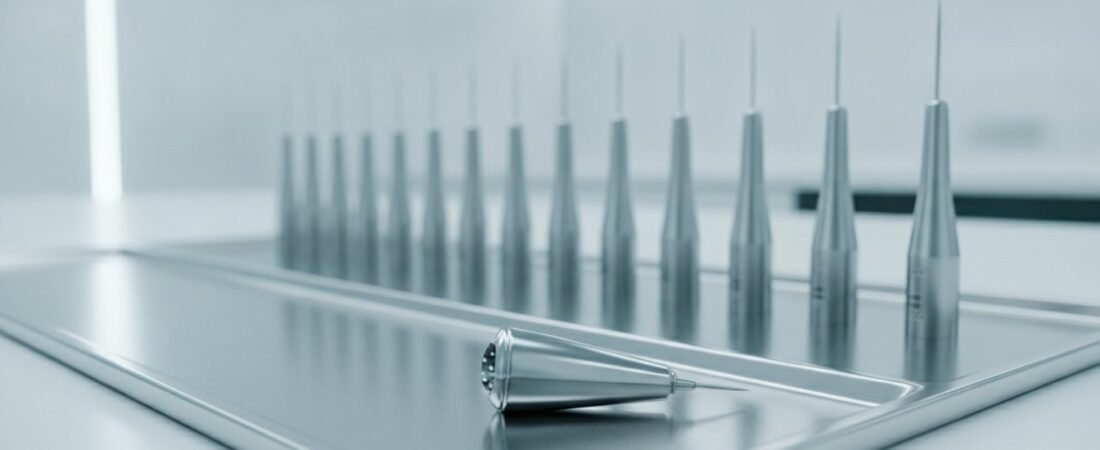
Would you trust a surgical outcome to a tool that lacks a verified quality pedigree? In the precision-driven field of hair restoration, the margin between a successful transplant and a failed graft often rests on the microscopic integrity of your equipment. You likely recognize that inconsistent survival rates and infection risks caused by sub-par materials aren’t just clinical setbacks. They’re direct threats to your patient’s trust and your clinic’s operational standing.
Choosing ISO 13485 hair transplant instruments has become the definitive benchmark for surgical excellence as we move into 2026. This certification ensures that every punch, blade, and implanter pen meets the rigorous international standards required for medical device safety and efficacy. By reading this guide, you’ll discover how standardized quality control directly improves graft survival and streamlines your path to regulatory compliance. We’ll examine the critical impact of the FDA’s Quality Management System Regulation (QMSR) update taking effect on February 2, 2026, and how Bind Pharma’s commitment to these global standards helps you avoid the import hurdles associated with non-certified devices. Prepare to elevate your clinical results through technical precision and uncompromising quality management.
Key Takeaways
- Understand why ISO 13485 is the mandatory quality management system for medical devices as the FDA harmonizes its regulations in early 2026.
- Learn how ISO 13485 hair transplant instruments utilize micron-level precision and surgical-grade materials to eliminate blunt-tip issues and improve graft survival.
- Identify the direct correlation between certified manufacturing standards and reduced clinical risks, such as folliculitis and high transection rates.
- Gain a step-by-step procurement strategy for verifying manufacturer certificates and material safety data sheets to ensure international regulatory compliance.
- Explore how Bind Pharma integrates certified manufacturing with specialized training to serve as a strategic partner for global hair restoration clinics.
Understanding ISO 13485 in Hair Transplant Instrument Manufacturing
Quality management isn’t a suggestion in surgical manufacturing; it’s a regulatory mandate. The ISO 13485 Standard represents the specific quality management system requirements for the medical device industry. While many manufacturers claim high quality, this certification provides the documented proof that a facility can consistently produce ISO 13485 hair transplant instruments that meet both customer and regulatory expectations. It’s the technical backbone that ensures a device is safe for clinical use.
In most global jurisdictions, hair transplant tools are classified as Class IIa or IIb medical devices. These aren’t simple hand tools. Because they penetrate the skin and interact with living tissue, they carry inherent risks. ISO 13485 differs significantly from the general ISO 9001 standard. While ISO 9001 focuses on general business processes and customer satisfaction, ISO 13485 prioritizes risk management and sterile manufacturing environments. It requires a level of technical rigor that general standards simply don’t address. This includes a strict traceability protocol. Every FUE punch or sapphire blade must be traceable from the finished product back to the specific batch of raw surgical steel or titanium used in its creation.
The Core Pillars of ISO 13485 for Surgical Tools
Risk management is the primary pillar of this certification. During the design and development phase of sapphire blades, manufacturers must identify potential failure points and mitigate them before production begins. The manufacturing facility itself must maintain strict environmental controls. This prevents contamination from particulates or microorganisms during the sharpening and assembly stages. Finally, every production batch undergoes rigorous verification and validation. This ensures that the tenth thousandth punch is as sharp and precise as the first one off the line.
Why Surgeons Should Demand Certified Equipment in 2026
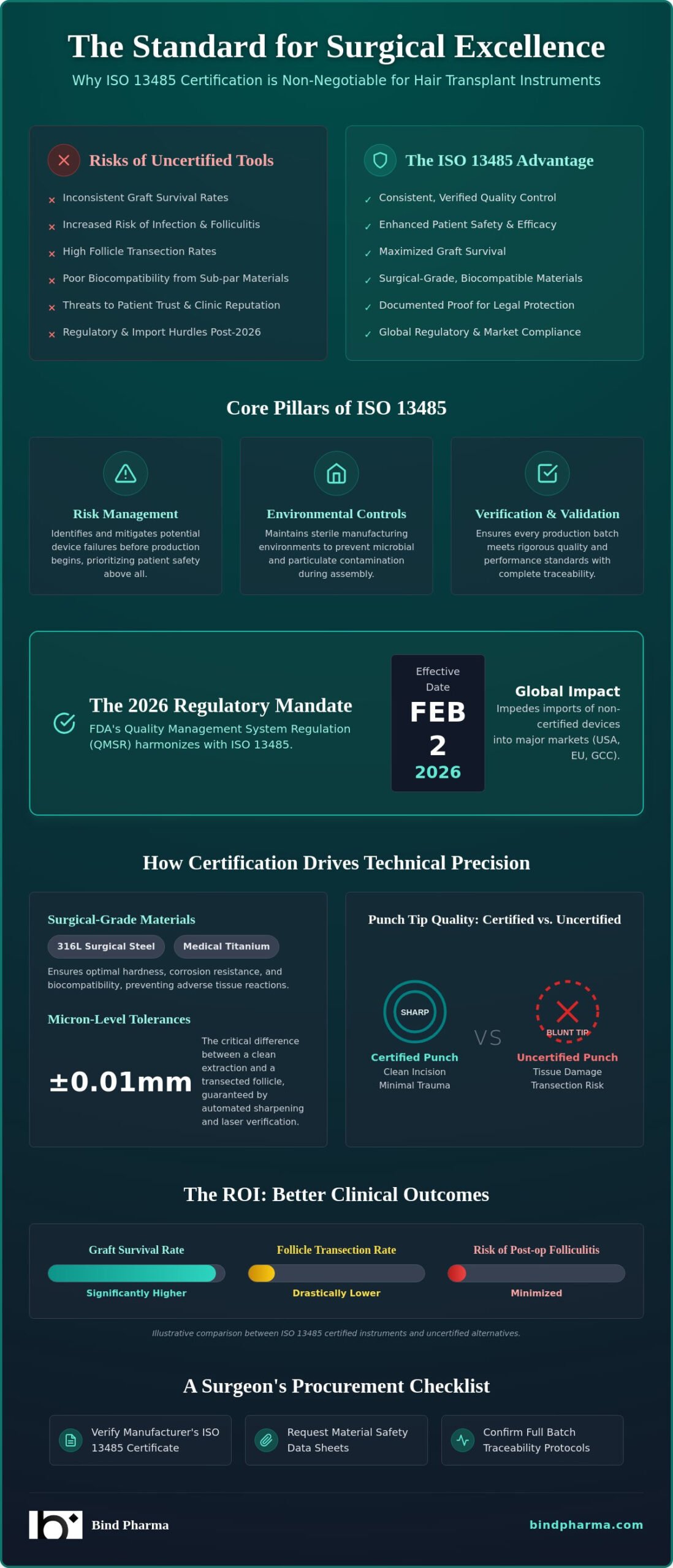
Surgeons face increasing legal and clinical liability. Using uncertified tools is a risk that modern clinics can’t afford. Certified ISO 13485 hair transplant instruments provide a documented paper trail of quality that protects the practitioner in case of complications. As of February 2, 2026, the FDA’s new Quality Management System Regulation (QMSR) harmonizes US law with ISO 13485. This means that importing non-certified devices into major markets like the USA, EU, or GCC will become increasingly difficult. Choosing certified equipment ensures your clinic remains compliant with international trade laws while maintaining the consistency in tool diameter and sharpness required for high graft survival rates.
Technical Precision: How Certification Impacts FUE Punch and Blade Quality
Technical excellence isn’t just about the surgeon’s hand; it’s about the engineering of the instrument. ISO 13485 hair transplant instruments are defined by their reliance on high-grade materials like 316L surgical stainless steel and medical titanium. These materials aren’t chosen by chance. They provide the necessary hardness and corrosion resistance required for repeated clinical use. The FDA Quality Management System Regulation harmonization underscores why these material standards are now the global baseline for 2026. Without these certifications, clinics risk using tools that may cause adverse tissue reactions due to poor biocompatibility.
Micron-level tolerances are where certification proves its value. In FUE surgery, a difference of 0.01mm can be the difference between a clean extraction and a transected follicle. Standard manufacturing often suffers from the “blunt tip” phenomenon, where mass-produced punches lose their edge during the finishing process. ISO-certified production lines use automated sharpening and laser verification to ensure every tip meets exact specifications. This precision is vital for creating the perfect V-shaped incision with sapphire blades, which minimizes trauma and speeds up the healing process. These engineering standards ensure that the instruments don’t just work; they perform with mathematical consistency.
FUE Punch Manufacturing: Beyond the Diameter
Advanced manufacturing focuses on more than just the size of the hole. Technical nuances like internal and external beveling determine how the punch interacts with the scalp’s resistance. ISO-certified designs often utilize thin-wall technology. This allows for a smaller external footprint while maintaining a sufficient internal diameter to protect the graft’s protective tissue. You can explore our technical specifications for FUE punches to see how these engineering choices impact surgical performance.
Sapphire Blades and DHI Pens: A Study in Sharpness
The molecular structure of monocrystalline sapphire allows for blades that are significantly sharper and smoother than steel. This smoothness reduces friction during the channel-opening phase, which leads to less edema and faster crusting. Similarly, DHI Implanter Pens must maintain consistent spring tension and needle alignment. If the tension is off, graft placement becomes erratic. Certified ISO 13485 hair transplant instruments are tested to withstand repeated autoclave cycles without losing their structural integrity or mechanical calibration. For clinics looking to upgrade their inventory with these high-precision tools, consult with our technical team for wholesale options.
Clinical Outcomes: The ROI of High-Quality Hair Transplant Instruments
Clinical outcomes serve as the ultimate metric for a hair restoration practice’s success. The adoption of ISO 13485 hair transplant instruments provides a measurable return on investment by reducing graft transection rates and improving patient recovery times. When a tool maintains its micron-level sharpness, it requires less force to penetrate the tissue, which significantly lowers the risk of mechanical trauma to the follicular unit. The FDA Quality Management System Regulation (QMSR) ensures that these performance metrics aren’t merely marketing claims but verified engineering realities that protect both the patient and the practitioner.
Standardized manufacturing protocols under ISO 13485 also mitigate the risk of post-operative complications like folliculitis and excessive scarring. Instruments produced in controlled environments with strict material traceability don’t harbor the microscopic contaminants often found in uncertified equipment. Precise incisions made by high-quality sapphire blades result in cleaner wound edges, which leads to faster crusting and minimized edema. These technical advantages translate directly into higher patient satisfaction scores and a more robust clinical reputation.
Ergonomics play a critical role in the design phase of certified tools. Hair transplant procedures are lengthy and demanding; surgeon fatigue can lead to subtle errors in graft placement or extraction angles. ISO 13485 hair transplant instruments undergo rigorous design validation to ensure that handle weight, grip texture, and balance are optimized for prolonged use. This focus on the human factor reduces the physical strain on the surgical team, maintaining the highest levels of precision from the first graft to the last.
Maximizing Graft Survival Rates
Protecting the follicular unit during the extraction phase is paramount. Precision FUE punches with optimized beveling allow for a smooth entry that avoids the “crushing” effect seen with blunt, non-certified tools. Similarly, DHI Implanter Pens must provide consistent needle alignment and spring tension to maintain proper graft hydration and orientation during placement. Graft viability is the measure of a follicular unit’s ability to survive and grow post-transplant, which is directly compromised by excessive tool friction and mechanical trauma.
Donor Area Preservation
Inconsistent punch sizing is the primary cause of the “moth-eaten” look in the donor area. ISO-certified manufacturing ensures that every punch in a batch is identical, allowing for a uniform extraction pattern that preserves the aesthetic integrity of the scalp. Furthermore, high-quality materials dissipate heat more effectively during micromotor-assisted extraction, minimizing thermal damage to the surrounding tissue. For a deeper look at tool selection, read our guide on FUE punch sizes and technical selection.
Procurement Strategy: Sourcing ISO 13485 Instruments Globally
Procuring medical devices for a modern clinic is a structured exercise in risk mitigation. Every instrument entering your sterile field must come with a verified pedigree of safety and performance. When sourcing ISO 13485 hair transplant instruments, you aren’t just buying steel; you’re investing in a documented quality management system. The first critical step is verifying the manufacturer’s certificate through official accreditation bodies. Don’t rely on a digital badge on a website. Request the actual certificate and check its validity date to ensure the facility’s QMS is current and compliant with 2026 standards.
Second, always request Material Safety Data Sheets (MSDS) for the raw materials used, such as surgical-grade stainless steel or monocrystalline sapphire. This documentation confirms the biocompatibility of the tools and protects your clinic from liability regarding adverse tissue reactions. Third, evaluate the manufacturer’s wholesale capabilities. A strategic partner must handle global shipping logistics with precision; ensuring that customs documentation is perfect to avoid delays at international borders. Finally, assess the availability of technical support or specialized training. High-precision tools perform best when the surgical team is trained in their specific nuances.
Why Turkey is the Global Hub for Hair Restoration Equipment
Istanbul has emerged as the definitive center for hair restoration, creating a unique synergy between high-volume clinical expertise and manufacturing prowess. Turkish manufacturers have a distinct advantage. They design tools based on the direct feedback of thousands of daily procedures. This results in cost-efficiency that doesn’t compromise on ISO medical standards. For European, American, and GCC clinics, Turkish partners offer a strategic bridge, providing premium hair transplant instruments that meet stringent regulatory requirements while maintaining competitive wholesale pricing.
Building a Comprehensive Surgical Kit
A high-performance surgical kit requires more than just punches. It must include a cohesive range of components: FUE micromotors with stable RPM control, precision forceps, and specialized sapphire blades. ISO 13485 certification ensures that every component in the kit works in harmony, maintaining the same quality standards across the entire extraction and implantation workflow. High-volume clinics should look for customization options that allow for bulk sterilization and specific handle weights. To ensure your suppliers meet these benchmarks, Download the 2026 Procurement Checklist for Instrument Distributors. For personalized wholesale inquiries and technical data, contact our global distribution team today.
Bind Pharma: Leading the Future of Certified Hair Transplant Tools
Istanbul stands as the global epicentre of hair restoration, and Bind Pharma operates at the very heart of this industry. Our facility is a dedicated, ISO 13485 certified manufacturing hub that serves as a strategic partner for the world’s leading clinics. This certification isn’t just a regulatory checkbox; it’s our promise of technical excellence to over 210 clinics across more than 20 countries as of July 2026. We understand that the surgical field demands more than just sharp tools. It requires a manufacturer that understands the entire clinical ecosystem. By integrating manufacturing precision with real-world surgical training, we ensure that every ISO 13485 hair transplant instruments we ship delivers peak performance in the operating room.
Our commitment to quality management extends beyond the production line. We’ve built our reputation on the vertical integration of manufacturing and education. While competitors often focus solely on distribution, we bridge the gap between hardware and skill. This approach ensures that your surgical team isn’t just using the best tools but is also equipped with the technical knowledge to maximize their potential. In a landscape where regulatory oversight is tightening, partnering with a certified manufacturer like Bind Pharma provides the security and consistency your clinic needs to thrive.
Precision-Engineered FUE and DHI Solutions
Our inventory focuses on the technical nuances that define modern hair restoration. We offer a specialized range of FUE punches, including gold-coated and titanium variants, with diameters ranging from 0.8mm to 1.0mm. These materials are selected for their durability and superior biocompatibility, ensuring they maintain their edge through rigorous, high-volume procedures. The ergonomics of Bind Pharma DHI Implanter Pens are equally critical. We’ve engineered the spring tension and needle alignment to provide surgeons with the tactile feedback necessary to reduce placement errors. You can view our complete catalog of hair transplant instruments to see the full scope of our technical offerings.
A Strategic Partnership for Your Clinic
We don’t just supply hardware; we provide the operational strength your clinic needs to scale. Bind Pharma supports clinics with both high-quality hardware and professional hair transplant teams for those requiring expert staffing solutions. Our Aesthetic Academy serves as a training ground where the next generation of specialists learns to master our ISO 13485 hair transplant instruments. Additionally, our post-transplant hair care range offers clinics a secondary revenue stream while ensuring patients receive the highest standard of aftercare. This holistic approach makes us a strategic partner rather than a simple vendor. If you’re ready to align your practice with the highest international standards, contact Bind Pharma for wholesale inquiries and ISO-certified equipment.
Elevating Surgical Standards through Certified Technical Excellence
The evolution of the hair restoration industry in 2026 demands a transition from traditional tools to certified medical devices. We’ve examined how standardized quality management removes the variables that compromise graft survival and clinical reputation. By integrating ISO 13485 hair transplant instruments into your daily workflow, you align your practice with the rigorous requirements of the FDA’s QMSR and the EU MDR. This transition isn’t just a matter of regulatory compliance; it’s a commitment to technical precision and patient safety that differentiates your clinic in a competitive global market.
Bind Pharma stands as your strategic partner in this journey toward surgical excellence. As an Istanbul-based global wholesale leader, we offer more than just premium hardware. Our specialized Aesthetic Academy training and professional staffing solutions provide a comprehensive framework for clinical growth and operational consistency. You don’t have to navigate these technical and regulatory challenges alone. Our team is ready to support your facility with the equipment and expertise required for world-class results.
Upgrade your clinic with ISO 13485 certified instruments from Bind Pharma. Your pursuit of surgical perfection starts with the uncompromising quality of your instruments.
Frequently Asked Questions
What is the significance of ISO 13485 for hair transplant tools?
ISO 13485 is the international standard for medical device quality management systems. It ensures that every instrument is manufactured under strict risk management and traceability protocols. For hair transplant tools, this means every production phase is documented to prevent contamination and ensure patient safety. It provides the technical foundation required for instruments that interact with living tissue during surgical procedures.
How do certified FUE punches improve graft survival rates?
Certified punches improve survival rates by maintaining micron-level sharpness and precise beveling. This engineering prevents the mechanical crushing of the follicular unit during extraction. When a punch is consistently sharp, it requires less force to penetrate the scalp, which significantly reduces the risk of graft transection. Quality control under ISO standards ensures this sharpness is uniform across every batch of tools.
Are ISO 13485 instruments required for FDA or CE compliance?
Yes, ISO 13485 is the recognized pathway for meeting EU MDR and FDA requirements. As of February 2, 2026, the FDA Quality Management System Regulation officially harmonized US law with ISO 13485. This makes the certification a prerequisite for manufacturers distributing medical devices in major global markets. It simplifies the regulatory process for clinics importing high-precision tools from international manufacturers.
What materials are used in high-quality hair transplant instruments?
High-quality instruments utilize 316L surgical stainless steel, medical titanium, and monocrystalline sapphire. These materials offer the necessary biocompatibility and corrosion resistance for clinical use. Using certified materials prevents adverse tissue reactions and ensures instrument longevity during repeated autoclave cycles. Every batch of raw material is verified through material safety data sheets to ensure it meets medical-grade standards.
Can uncertified instruments affect the healing process of the donor area?
Uncertified instruments often cause excessive tissue trauma due to blunt edges or inconsistent diameters. This results in larger wound sizes, increased scarring, and a depleted appearance in the donor zone. Precise, certified tools create clean incisions with minimal friction, which promotes faster crusting and reduced post-operative edema. Choosing the right equipment is essential for preserving the aesthetic integrity of the patient’s scalp.
How often should ISO-certified surgical forceps and punches be replaced?
FUE punches should be replaced after 500 to 1,000 extractions to maintain optimal sharpness. While surgical forceps are more durable, they require replacement if the tips become misaligned or lose their gripping tension. Regular inspection is a mandatory part of the quality control protocol for clinics using high-precision equipment. Using worn tools increases the risk of graft damage and surgical inefficiency.
Why should clinics source instruments from an ISO 13485 certified manufacturer in Turkey?
Turkey is the global hub for hair restoration, providing a unique synergy between clinical expertise and manufacturing prowess. Sourcing ISO 13485 hair transplant instruments from Turkish manufacturers like Bind Pharma ensures your clinic receives tools tested in high-volume environments. This geographic hub offers cost-efficiency without compromising on international medical standards. It also provides access to specialized training through institutions like our Aesthetic Academy.
What is the difference between a standard punch and an ISO-certified FUE punch?
The primary difference lies in documented traceability and technical tolerance. A standard punch often lacks the engineering rigor found in ISO 13485 hair transplant instruments, leading to inconsistent sharpness and unpredictable wall thickness. An ISO-certified punch undergoes rigorous batch testing to ensure every tip meets exact micron-level specifications. This consistency is vital for surgeons who require predictable outcomes and low transection rates during every procedure.